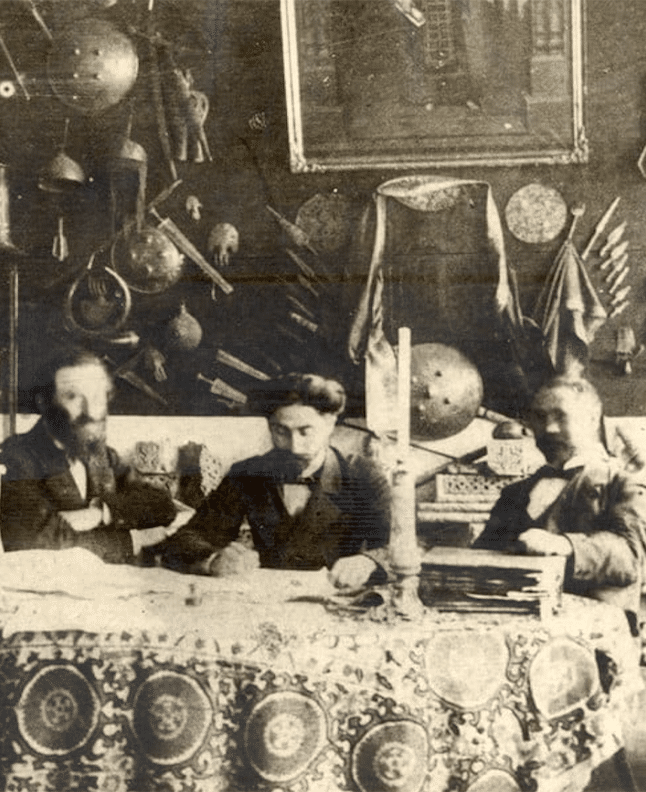
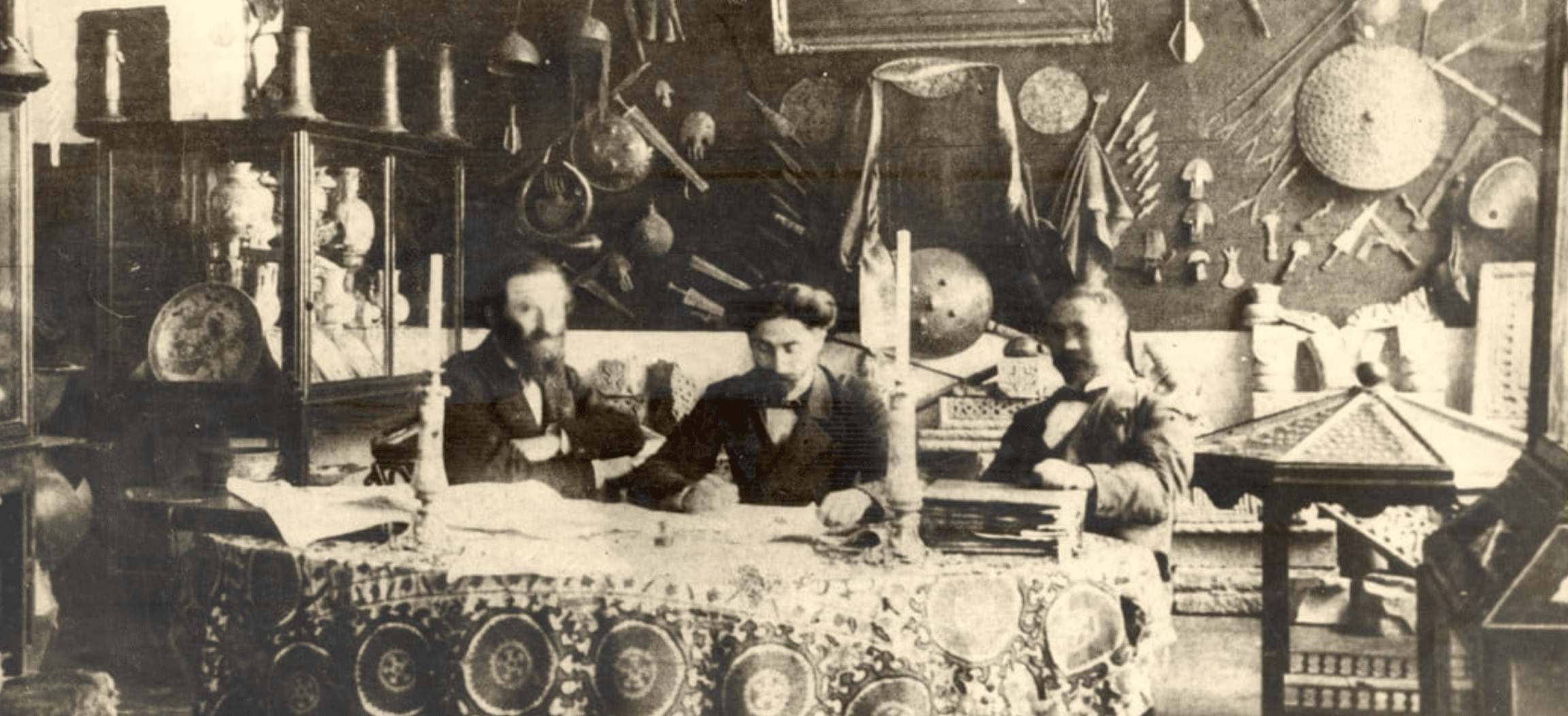
One evening in the 1860s, in Tbilisi, Iakob Gogebashvili and Niko Tskhvedadze met at the home of Georgian writer and public figure Ioseb Mamatsashvili. Such evenings were common among Georgian families at the time, serving as an excellent opportunity for open discussions about the country's future. Yet, under the rule of the Russian Empire, they had little hope for change.
It was at one of these evenings that the idea to create the Society for the Spreading of Literacy among Georgians (the Literacy Society) was born, and it was to become the first civic organization of its kind in Georgia. The idea was later shared with the distinguished patriot and mayor of Tbilisi, Dimitri Kipiani. Dimitri Kipiani, Ilia Chavchavadze, Niko Tskhvedadze, Vakhtang Tulasvhili, and Iakob Gogebashvili went on to make the greatest contributions to this Society.
Iakob Gogebashvili recalled how warmly the “dear teacher” Dimitri Kipiani welcomed the proposal. At the time, Iakob was suffering from tuberculosis, and had to stop working on the Society’s charter for a time to rest. When he saw the final version that had been made by others in his stead, he was dissatisfied. The core idea behind the Literacy Society—that education should be conducted in the Georgian language, understandable to peasants, and not in Russian—had been lost. It was a concept that, in his view, should have been clearly defined in the charter.
“If this article is not included in the charter, the establishment of the Society will be pointless, because bureaucracy will have the right to demand that teaching in the community schools be conducted in Russian. In that case, our Society will not serve the education of the Georgian people, but, instead, will contribute to their assimilation and intellectual decline,” he said.
Dimitri Kipiani, however, feared that the authorities would not approve the charter in such a form.
Gogebashvili’s reasoning won out, and Article 3 was added to the charter, defining the main goal of the Literacy Society as “spreading literacy among Georgians living in the Caucasus Governorate and achieving the provision of primary education in their mother tongue.”
When the charter was prepared, on January 30, 1878, the founders met at the home of poet Grigol Orbeliani. It was unanimously decided that, since the Russo-Turkish War was ongoing and Russia was not in a favorable situation, they should take advantage of the circumstances and submit the charter for approval in St. Petersburg forthwith. On June 20, 1878, Dimitri Kipiani, Ilia Chavchavadze, and Nikoloz Ghoghoberidze addressed General-Lieutenant Staroselsky, head of the administration of the Caucasus Viceroyalty. They had to wait an entire year before they received a response. It seemed, as expected, that the main obstacle to approval was that very third article which Iakob Gogebashvili had insisted on including in the charter. It was a provision especially opposed by Kirill Yanovsky, the trustee of the Caucasian educational district, who had already expelled the Georgian language from educational institutions.
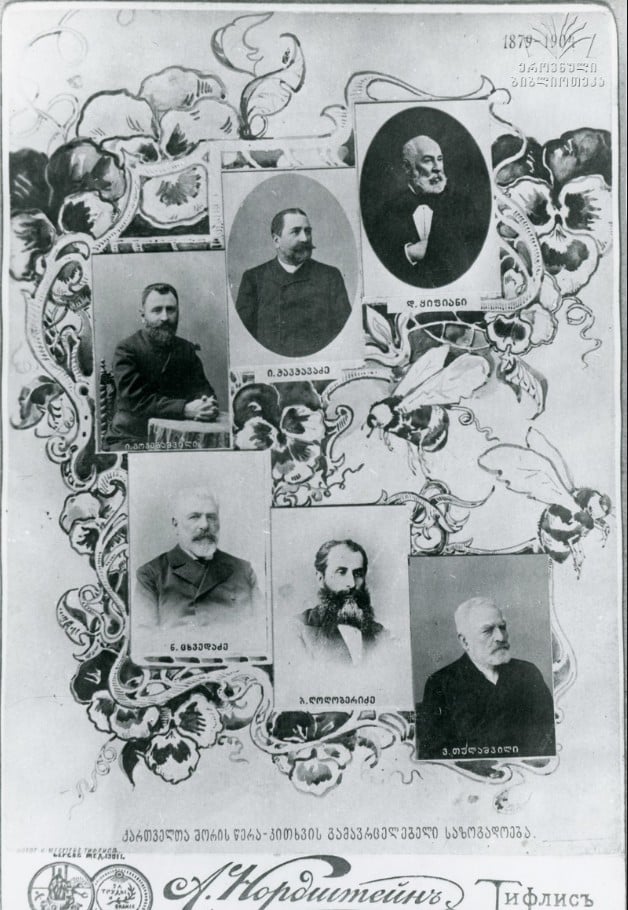
Founders of the Society for the Spreading of Literacy among Georgians. From the collection of the digital library ‘Iverieli.’
Finally, approval was given with amendments. Dimitri Kipiani was notified of this on April 14, 1879. A month later, on May 15, the first general assembly of the “Tbilisi Society” was held in the building of the Nobility Bank. As stated in the founding protocol, “the purpose of the Society is to spread knowledge of books and education among Georgians in the Caucasus Viceroyalty.” The document was signed by the chairman of the society, Dimitri Kipiani, and board members Ilia Chavchavadze, Iakob Gogebashvili, Ivane Machabeli, Niko Tskhvedadze, and Raphael Eristavi. For this reason, May 15 is recognized as the founding date of the Society, “which is not only a cultural institution, but also our national refuge,” noted the board’s report.
.jpg)
The founding protocol of the Society for the Spreading of Literacy among Georgians, signed by the society’s chairman Dimitri Kipiani and board members Ilia Chavchavadze, Iakob Gogebashvili, Ivane Machabeli, Niko Tskhvedadze, and Raphael Eristavi. From the collection of the National Archives of Georgia
This Society promoted literacy—at a time when only about 2–3 percent of Georgia’s population was literate—and served as a publisher and distributor of books. It functioned as a national archive, museum, and library, institutions that did not exist in Georgia at the time, and became the principle center where national life was formed and developed. Established by a small group of individuals, the Literacy Society achieved its mission despite numerous restrictions and opposition from the Russian Empire, awakening national ideas, spreading education, preserving cultural heritage, and instilling hope and confidence among Georgian society.
The Literacy Society unanimously requested the poet Grigol Orbeliani serve as chairman, but he regretfully declined, citing ill health. Dimitri Kipiani was then unanimously elected to the position.
.jpg)
Between 1879 and 1918, the Society was led by Dimitri Kipiani, Ivane Bagration-Mukhraneli, Ilia Chavchavadze, and Giorgi Kazbegi. From the collection of the National Archives of Georgia
Under Russian occupation, there was a real threat that all signs of statehood would disappear. The only remaining path to survival was the spread of education. The Society’s main goal was therefore to restore Georgian consciousness among the people. It attracted influential individuals and public figures as founders., and was joined by the new generation of the 1860s, known as the “Tergdaleulebi,” who demanded innovation in public life, and who considered the Society for the Spreading of Literacy as the driving force of the Georgian national movement.
The Literacy Society survived on membership fees, donations, support from the Nobility Bank, income from its bookstore, and funds raised through special events organized on its behalf.
Ilia Chavchavadze proposed sending society agents to negotiate the opening of schools in villages in the regions, but the local authorities refused to even receive them.
In 1881, one of the first schools was opened in Batumi. At 66 students, the building was soon found to be too small, so classes were divided into two “shifts.” Both Muslims and Christians studied together. The school faced many issues, and, to address them, it was decided to hold an event each year on January 14 at which to raise funds for the school. At the first such event, Akaki Tsereteli traveled to Batumi to attend. More than 3000 rubles were collected, and, according to writer Davit Kldiashvili, this saved the school from further hardship.
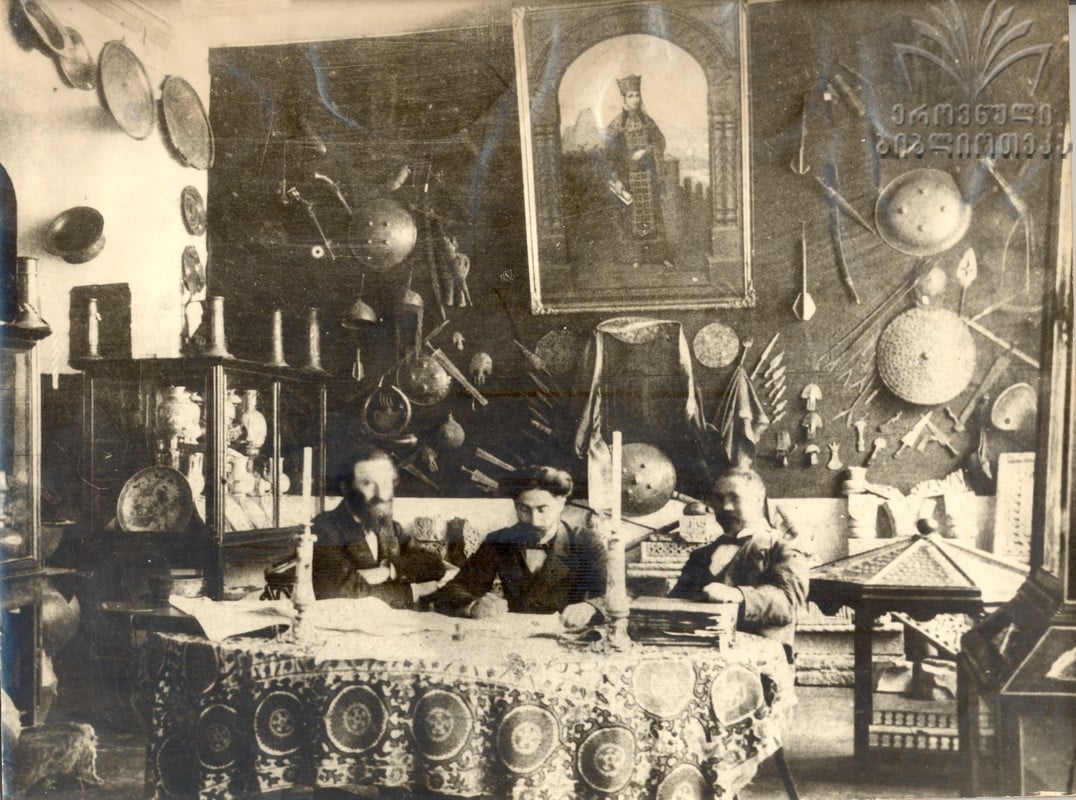
The Society for the Spreading of Literacy. A photo by Aleksandre Roinashvili. From the collection of the digital library ‘Iverieli’.
Such schools were eventually opened countrywide, from Abkhazia to Saingilo. Special attention was given to those regions where teaching the Georgian language was problematic, In 1893, in Kavkav (Vladikavkaz), the Literacy Society opened a school in its own building, where 65 poor Georgian children were given the opportunity to study. Interestingly, the Baku branch was the most successful of the Society’s projects, with a special-purpose school building constructed through donations from writer and public figure Iakob Mansvetashvili. Indeed, the Society’s attention was to reach even Fereydan in Iran.
The Literacy Society also provided scholarships to exceptional young people. A teacher at the Kavkavi school once wrote a letter to Davit Karichashvili, stating, “We have a very talented but incredibly poor young fellow who is a servant of a Russian man.” The owner of the house enrolled him in the gymnasium, where he impressed everyone with his abilities. The Society then gave him a scholarship and advised him to move into his own apartment so that he could study properly. The young man was Pavle Ingorokva, who later became a renowned scientist.
Following Dimitri Kipiani's murder in 1887, Ivane Bagration-Mukhraneli led the Literacy Society for several years before Ilia Chavchavadze was elected as chairman. He went on to serve the Society for 25 years. Ilia was supported by Niko Tskhvedadze, a teacher, writer, one of the founders of Tbilisi State University, and the architect of the university's first building, who also served as the district administration's deputy chairman.
Ilia Chavchavadze sought to aid the Literacy Society in every way possible. He once hosted a meeting and donated the revenues — 550 rubles — to the foundation. Such evenings were frequently hosted at his and his wife Olga Guramishvili’s initiative.
Assistance to Georgian regions expanded by the year. Schools and reading rooms were established, talented young people were funded, and Georgian writers were encouraged. The Society decided to publish Georgian school textbooks, and organized a competition for this purpose. Iakob Gogebashvili's Deda Ena ("Mother Tongue") won. Every year, 20-25,000 copies of this distinctive Georgian language textbook were sold. By 1916, sales had hit 550,000 copies.
The Georgian press of the era frequently featured statements like these: "Please, through your publication, express your gratitude to the Literacy Society for delivering 25 volumes of Mother Tongue free of charge for the benefit of the Lailashi Parish School, established by me. The next day, other children arrived and exclaimed, ‘We want to learn too!’” wrote Priest I. Gersamia in the newspaper Droeba.
“Vazha-Pshavela would come to the Literacy Society twice a year, asking for four or five tumans (a form of currency), either as a loan or as an advance on works to be printed, because he had no one else to support him.”
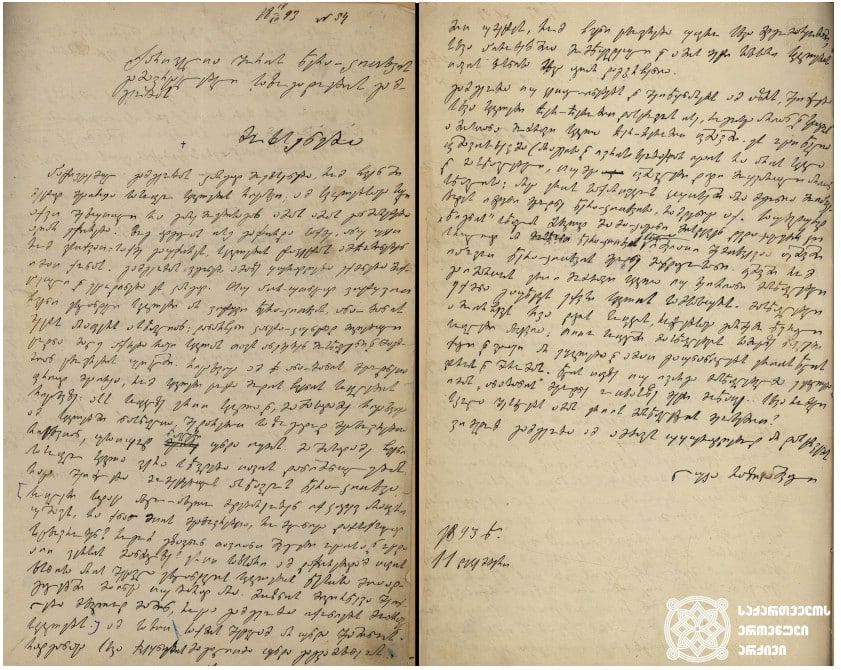
Vazha-Pshavela (Luka Razikashvili) reports the launch of a mobile school in Pshavi to the board of the Society for the Spreading of Literacy among Georgians. December 17, 1893. From the collection of the National Archives of Georgia.
"The desire to learn compels us to turn to the Literacy Society through Iveria to help us and support us, just as they support other schools... If the Society leaves us inconsolable, then we will have no choice but to... throw ourselves into the water, hated by everyone," wrote the young men of Bakurtsikhe.
At the Society's expense, Nikoloz Baratashvili's remains were transported to his motherland in 1893 and interred at the Didube Pantheon.
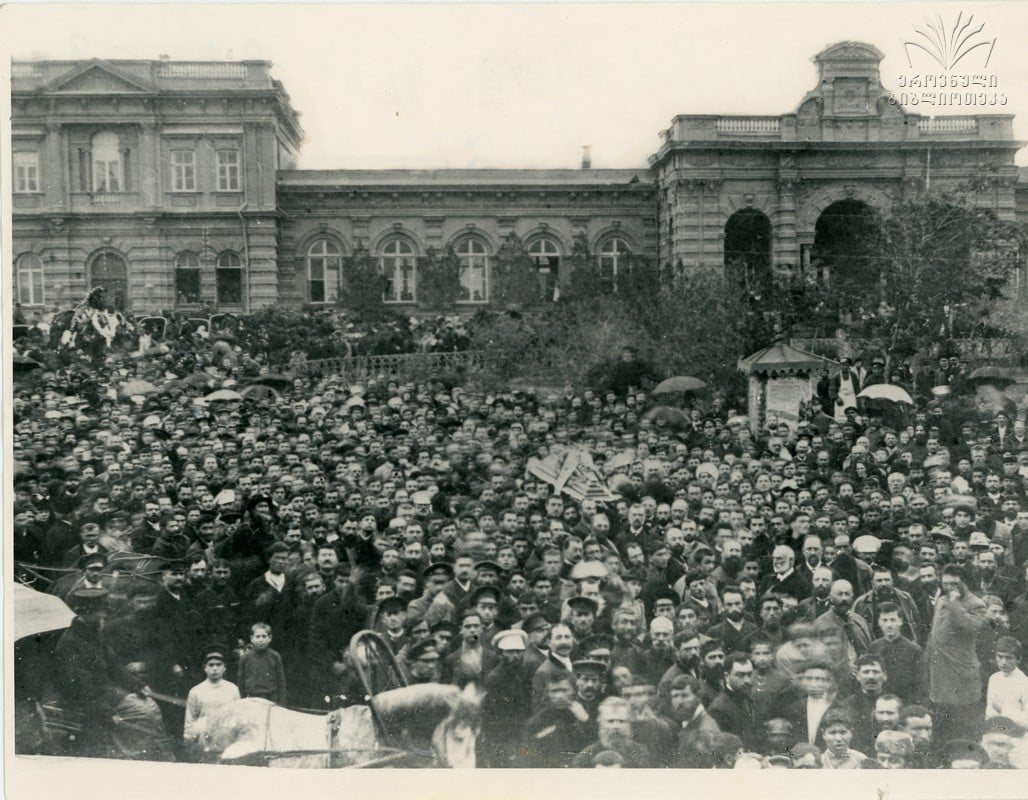
Nikoloz Baratashvili's remains being transported to Tbilisi. 25 April 1893. From the collection of the digital library ‘Iverieli’.
Among further works supported by the Society, Iakob Nikoladze commissioned the group to build a memorial to Ilia Chavchavadze on Mtatsminda, and Giorgi Kartvelishvili, one of the most well-known businessmen and art patrons of the time, issued a special edition of The Knight in the Panther's Skin in 1888. Hungarian artist Mihály Zichy was invited to illustrate the book. So impressed was he by the poem and the work of the Literacy Society, he gave his illustrations without payment, offering his work as a gift to the Georgian people.
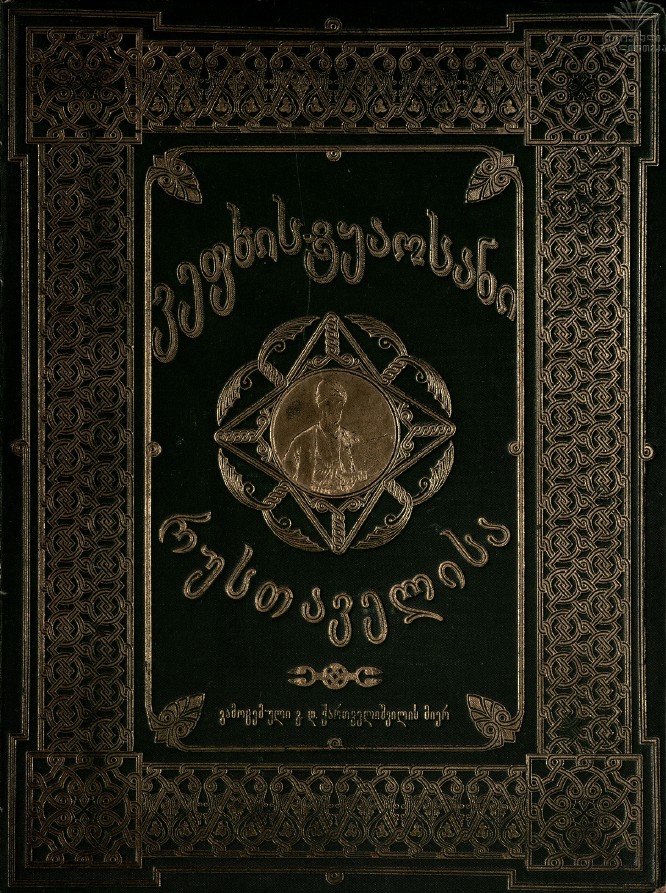
‘The Knight in the Panther’s Skin’ (1888 Kartvelishvili edition) and one of the images created for it by Mihály Zichy. From the collection of the digital library ‘Iverieli’.
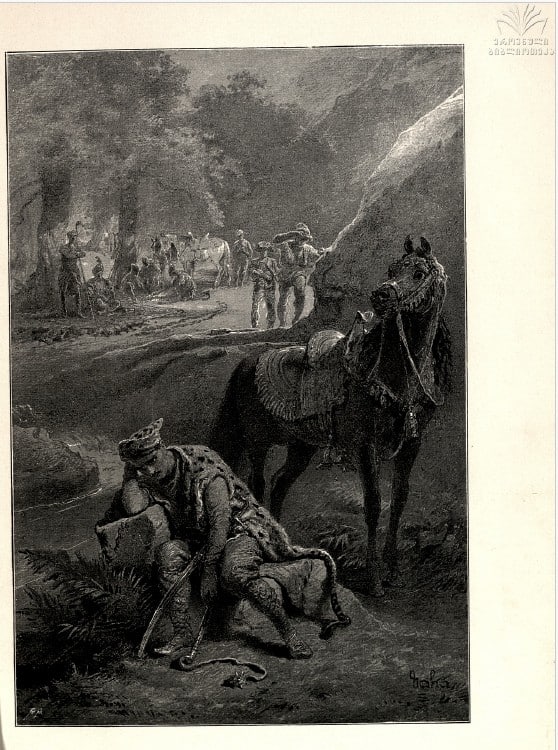
‘The Knight in the Panther’s Skin’ (1888 Kartvelishvili edition) and one of the images created for it by Mihály Zichy. From the collection of the digital library ‘Iverieli’.
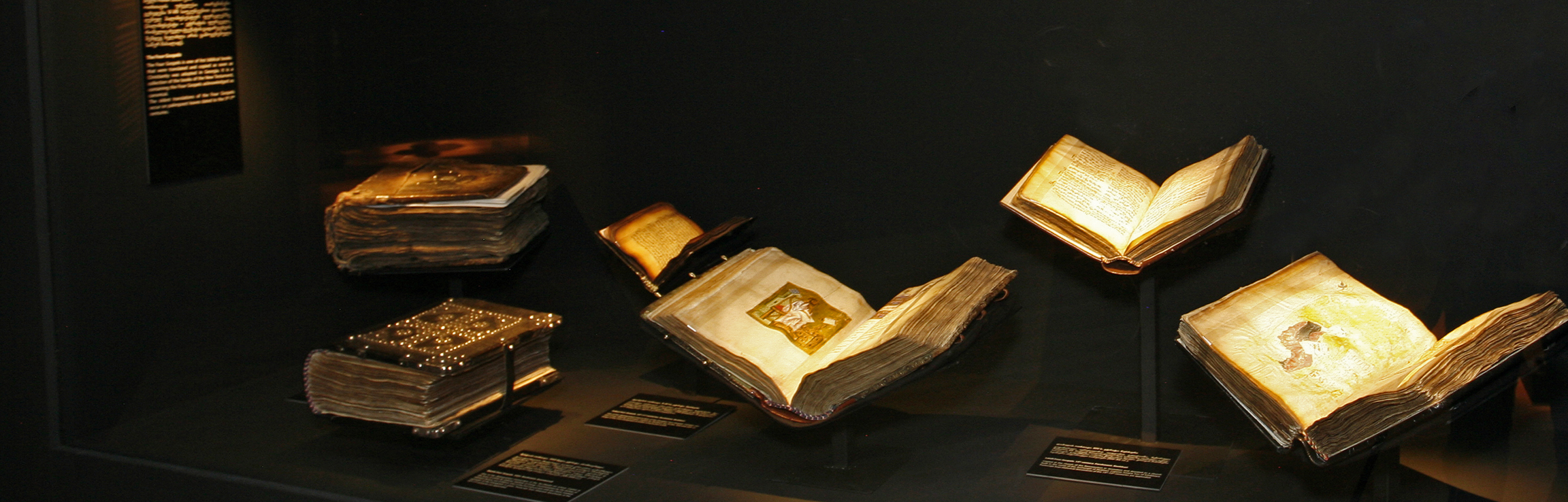
One of the primary activities of the Literacy Society was the search and preservation of historical manuscripts, papers, and deeds. At that time, as the critic and translator Aleksandre Sarajishvili remarked, historical artifacts were “dying” in Georgia: “7,000 different books and manuscripts housed in the Mtskheta library were lost, and a wonderful icon of the Savior (6th century) disappeared from the church. Books and other valuables were taken from the Jumati Monastery, and the collections of the Kvatakhevi and Bodbe monastery libraries were taken and broken up. Dimitri Bakradze unearthed a wonderful collection of four canonical gospels in the courtyard of one temple, while, in the trash next to the Nikozi temple, Mr. Bakradze discovered another manuscript dating back to the ninth century.”
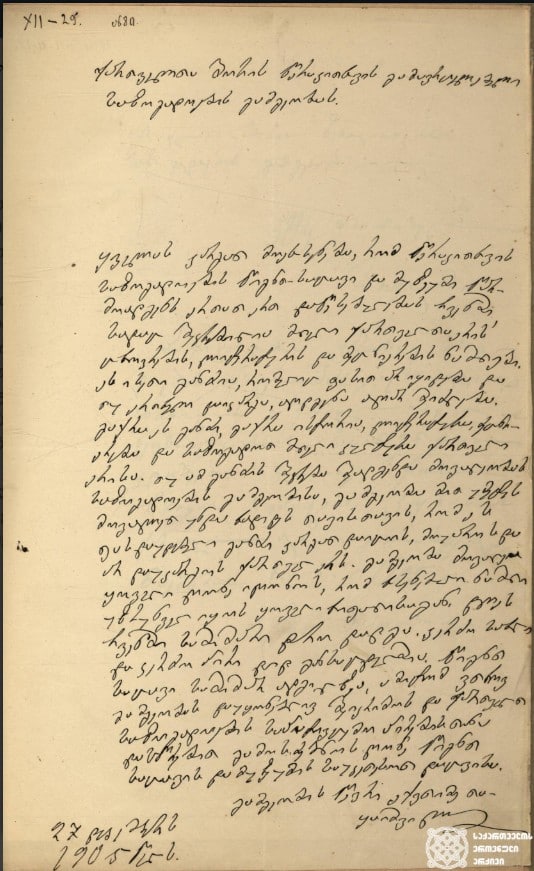
Ekvtime Takaishvili's appeal to the Society for the Spreading of Literacy's board regarding the secure transfer of artifacts housed in the organization's museum and library. December 27, 1905. From the collection of the National Archives of Georgia.
The Society for the Spreading of Literacy among Georgians safeguarded, collected and published several relics of Georgian writing. Just a year after it was founded, it had more than 200 printed works and twice as many handwritten manuscripts at its disposal. It is especially remarkable that Ekvtime Takaishvili made a great contribution to collecting manuscripts of The Knight in the Panther’s Skin. Following the handover of Raphael Eristavi's library to the Society, Samegrelo Prince Niko Dadiani made the largest donation to the community in the region, in 1855 presenting the Society his own library, which included 169 manuscripts and printed works. Niko Dadiani was thereafter made an Honorary Member.
In order to support the Society for the Spreading of Literacy, many prominent Georgians donated their wealth and assets to the community. Georgian philanthropist David Sarajishvili left a large sum, and the Zubalashvili brothers donated 20,000 rubles. In 1905, Ilia Chavchavadze wrote in his will that he was leaving all his property to his wife, after whose death it was to be transferred to the Literacy Society. Soon after Ilia was assassinated in 1908, Olga Chavchavadze consented to pass their Saguramo estate to the Society.
Iakob Gogebashvili also bequeathed his property to the Society, amongst which was a rich library, his own textbooks, their printing clichés, and other publications.
“The only thing I think about is that the Literacy Society should take good care of my Mother Tongue and spend its income wisely,” he said.
According to his contemporaries, Iakob Gogebashvili's final words were: “Mother Tongue is a great thing for our nation. If King Erekle were alive, this textbook would be the same as the one I left recently."
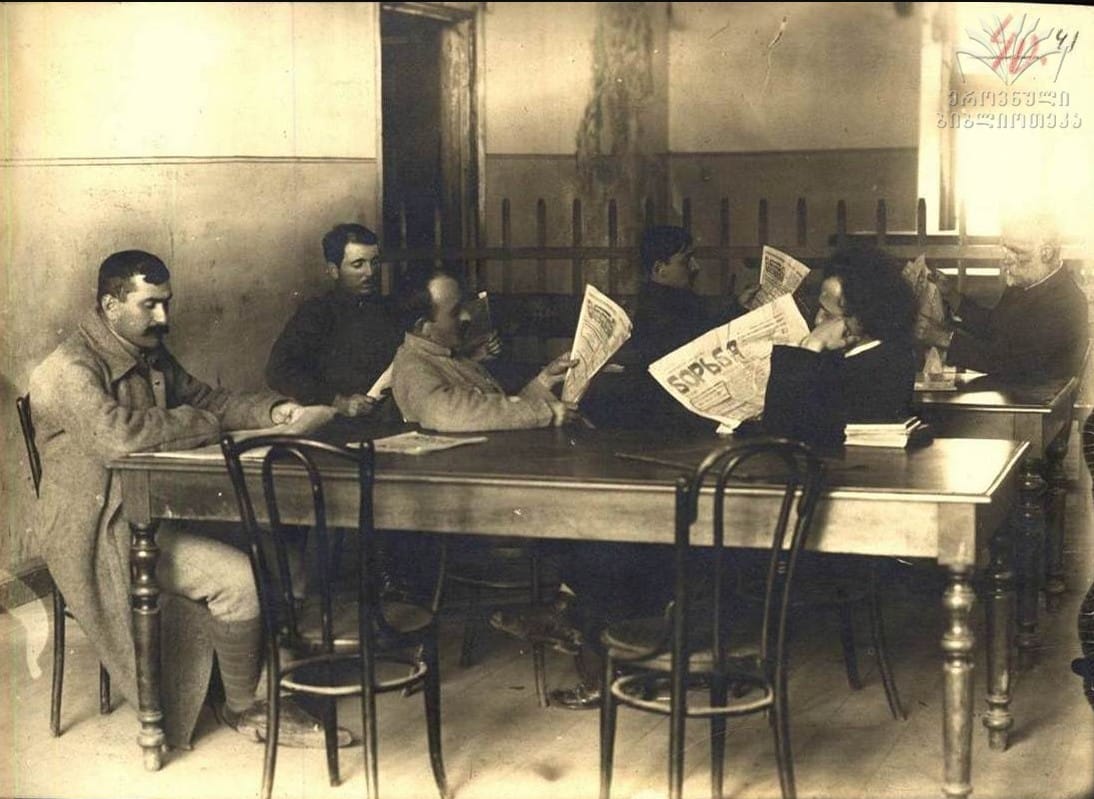
The public reading hall of the Society for the Spreading of Literacy among Georgians, Poti branch. From the collection of the digital library ‘Iverieli’.
Akaki Tsereteli left his house and garden in the village of Skhvitori to his wife and children, and willed that, later, it was to be handed over to the Literacy Society. His wife and children relinquished their rights.
In the 1910s, Georgia’s political situation went through a transformation, and attempts were made to introduce political issues into the Society's activities. First, the Social Democrats sought to make the Literacy Society a mass organization, to lower the membership fee, and to gain control over its management. Then, following their occupation of Georgia, the Bolsheviks sought to hinder its activities. One zealous Bolshevik representative, Philipe Makharadze, asked the Society's leaders: "Why are you spending money on these old things?"
The author of the most recent significant research on the history of the Society for the Spreading of Literacy among Georgians, Oliver Reisner (The School of the Georgian Nation, Tbilisi, 2005), notes that "with the help of Ilia Chavchavadze's personal authority, the Society for the Spreading of Literacy among Georgians stood in opposition to Tsarism's aspirations, and was able to find compromises."
Following the declaration of Georgia's independence, the Society’s public significance as an educational institution gradually diminished: its foreign branches were closed, most of its members moved to work in the state institutions of the First Republic, and, after the occupation of Georgia in 1921, "its existence took on the form of a nostalgic remnant of the Tsarist era, and was gradually absorbed by state institutions."
In 1922, the organization was renamed the "Book Publishing and Distribution Society," and its purpose was strictly limited to publishing.
Publicist and lawyer Iason Lortkipanidze reiterates the Soviet authorities' unhappiness with the charter: "We name our firm as it is approved: the ‘Book Publishing and Distribution Society of Georgia.’ They don't like the final version... I'm not sure how this case will be resolved. They have demanded our charter and all paperwork from the Commissariat of Internal Affairs be reviewed by another institution. I believe we will have to close the Society."
The day after Georgia's Sovietization, Davit Karichashvili, the chairman of the Literacy Society's library-museum, wrote to the Tbilisi Revolutionary Committee: "Protect the museum and library. The Society was in a terrible state; it no longer had any money... The museum and library were housed at Tbilisi University.”
The Society was dissolved in 1926. The People's Commissariat of Education gave the Writers' Union the Society's property, while Tbilisi State University received the library, museum, and archive. These included 2,214 manuscripts, 1,600 deeds and documents, 5,286 Georgian-published books and 6,348 in other languages, as well as archaeological, numismatic, ethnographic, and photographic objects. Cases of book loss grew more common. Ioseb Grishashvili found and bought the Society's printed books at a market and delivered them to the university himself. "As long as I am alive, the Georgian people will not lose the books of this Society," the poet declared.
The manuscripts were transferred to the National Museum’s Manuscript Department (now known as the ‘S’ collection) in 1937, and the Society’s book fund was brought to the public library by cart, where it was combined with other library funds. The Literacy Society's book fund was separated in 1999, and Ilia Chavchavadze's personal library was restored, with more than 100 copies retrieved, alongside the personal library-collections of Raphael Eristavi, David Chubinashvili, and Dimitri Bakradze.
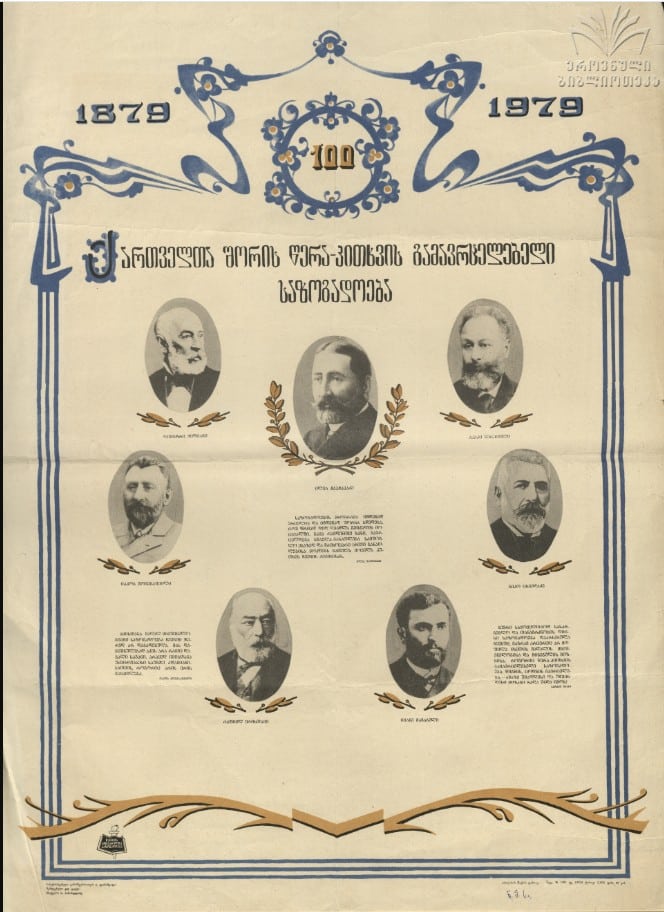
In 1979, the Society celebrated its 100th anniversary. Anniversary posters. From the collection of the digital library ‘Iverieli’.
The Literacy Society's final work was to organize the funeral of Ilia Chavchavadze's widow, Olga Guramishvili, on April 24, 1927.
“Olga, whose husband had made significant contributions to our Society, was so destitute in her final years that she sold her own books at the market. During these April days, the Society's liquidation act was also written.”