Georgians seem to start learning wrestling and the alphabet at the same time. - Shozo Sasakhara.
- World and Olympic champion
In October 2025, Tbilisi hosted the Georgian Wrestling World Championship. One hundred athletes from 25 countries around the world competed for the prestigious wrestling title. The competition featured participants from a diversity of countries, among them Turkey, Greece, Mongolia, Egypt, Brazil, Japan, Iran, and Estonia. The celebration of this national sport culminated in a compelling masterclass, where Georgian wrestlers showcased traditional techniques and unique technical moves to the visiting athletes. Behind this achievement lies centuries of experience and a rich cultural heritage.
At the end of November 2018, the 13th session of the UNESCO Committee for the Safeguarding of Intangible Cultural Heritage was held in the city of Port Louis, Mauritius.
The session started in an unusual way: before the official agenda was adopted, during the opening ceremony, UNESCO unanimously recognized the joint nomination of North and South Korea for the national wrestling tradition "Ssireum/Ssirum" as a UNESCO Intangible Cultural Heritage. For the North Korean delegation, this significant cultural event became a unique opportunity to send a positive message to the rest of the world.
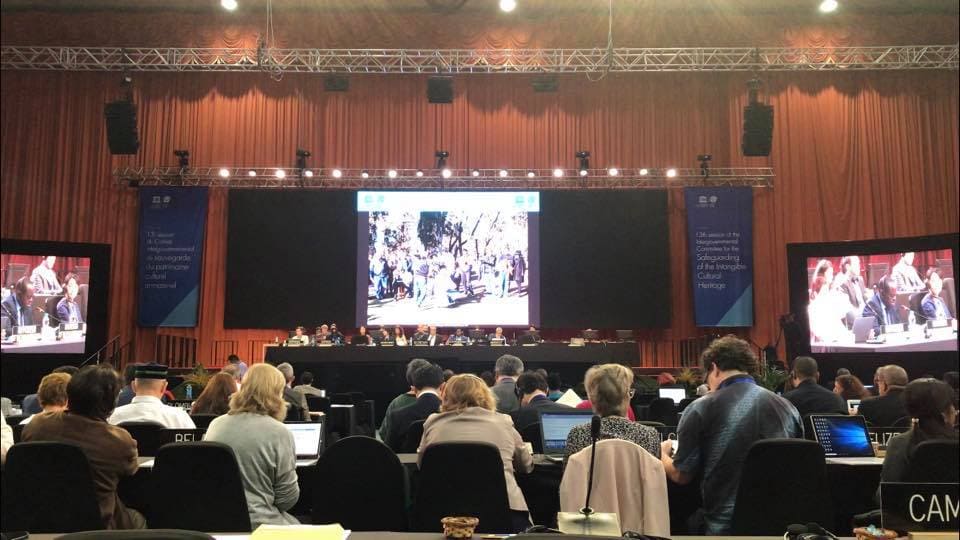
UNESCO 13th session in Port Louis.
At the same session, where tradition transcended borders, Georgian wrestling, known as Chidaoba, was also inscribed on the UNESCO Representative List of the Intangible Cultural Heritage of Humanity. This marked a historic moment of justice and an international acknowledgment of the centuries-old tradition of Georgian wrestling. Inclusion on the Representative List signifies not only symbolic recognition, but also integration into the international framework for the protection and promotion of cultural heritage.
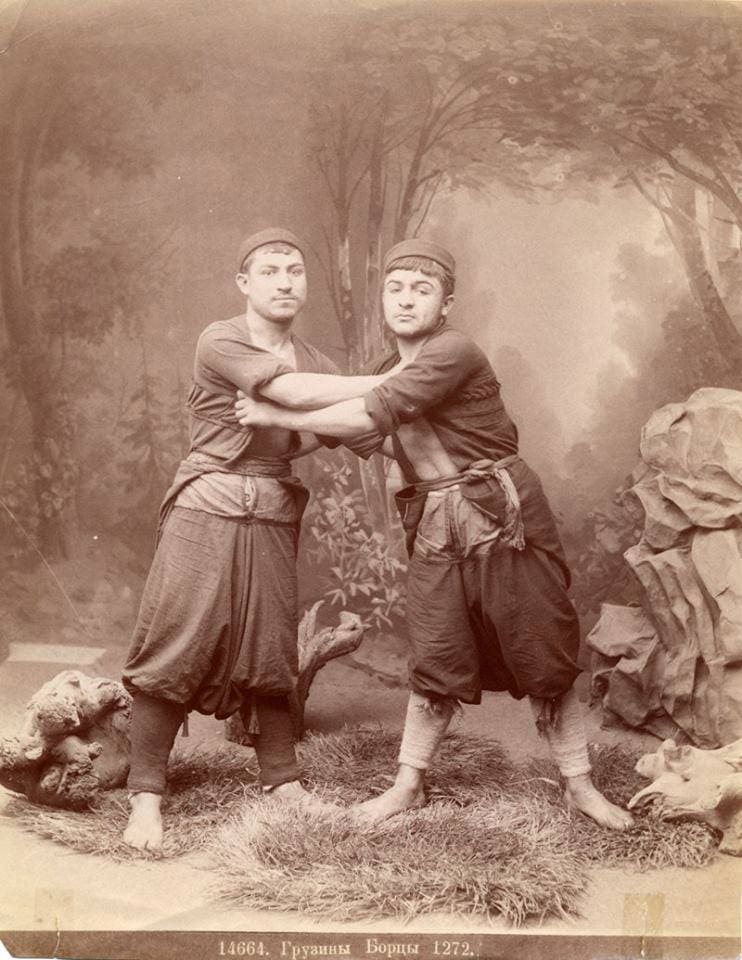
Wrestlers from Tbilisi. Early 20th century. Tbilisi History Museum.
At that time, the UNESCO Representative List already included Kazakh belt wrestling, "Kuresi"; the Türkiye’s Kırkpınar oil wrestling festival; Iran’s "Pahlevani and Zoorkhaneh" rituals; and Azerbaijan’s "Pehlevanlig." Within this context, the recognition of Georgian wrestling was a natural and fair step to take.
The inclusion of traditional wrestling practices in the framework of intangible cultural heritage provided an important stimulus for the development of Georgian wrestling. The President of the Georgian Wrestling Federation,Gela Beruashvili, played a significant role in this process. It was at his initiative that intensive efforts began in late 2013 to secure recognition of Georgian wrestling as an element of intangible cultural heritage. Distinguished athletes, sports journalists, wrestling experts, and scholars of intangible cultural heritage worked collaboratively and tirelessly to achieve this important goal. As a result, in August 2014, Georgian wrestling was officially recognized as an element of intangible cultural heritage. It was later elevated further, in January 2017, when by the decree of the Prime Minister of Georgia, it was defined as a national category.
Throughout its long and turbulent history, Georgian wrestling has been regarded as a form of preparation for combat. Its rapid techniques, precise movements, full command of the body, and artistry in execution formed a disciplined system that young men began learning from early childhood. In regions such as eastern Georgia, where external threats were frequent, this practice served as an effective method of martial training.
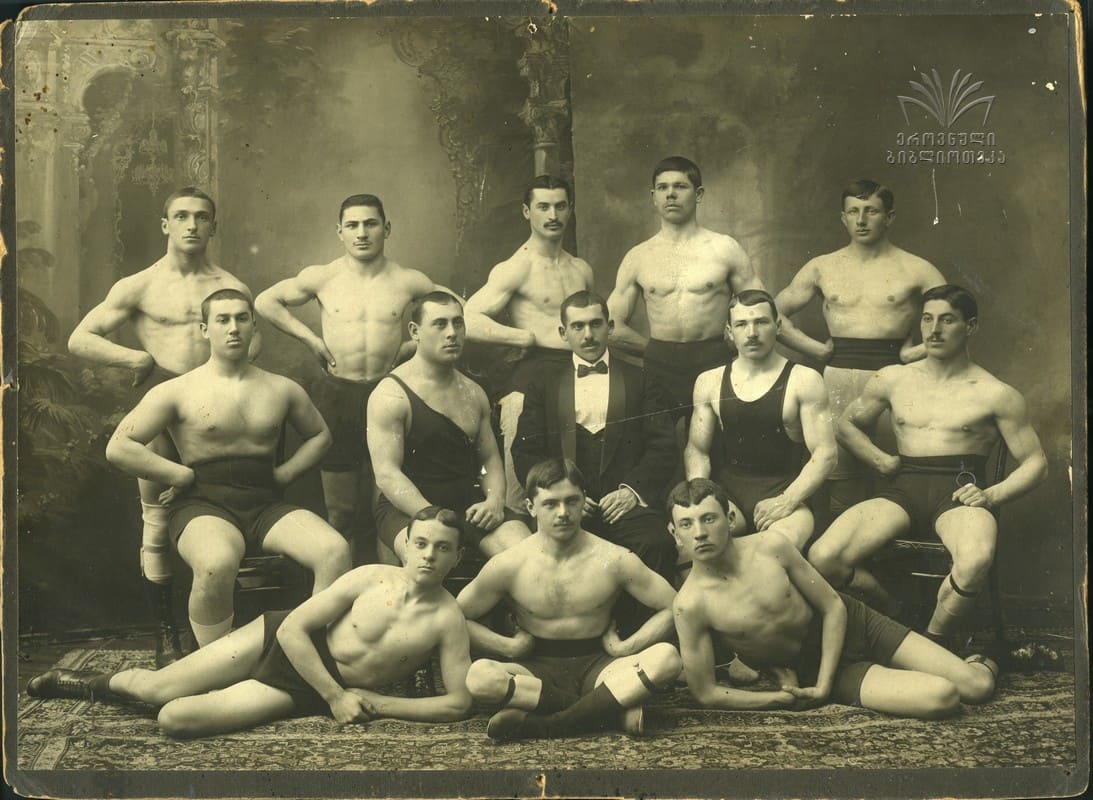
Tbilisi wrestlers group. 1930s. National Library.
Over time, Georgian wrestling lost its direct military function and evolved into a refined and visually compelling performance. Nevertheless, the chivalrous ethos and moral foundations of the wrestler have remained unchanged: an attack ceases when an opponent is brought to their knees; the contest continues only while both wrestlers remain upright; and the use of deceptive or dishonorable techniques is considered a violation of the wrestler’s dignity. These principles are not merely rules of the sport, but form an integral part of Georgian ethical tradition.
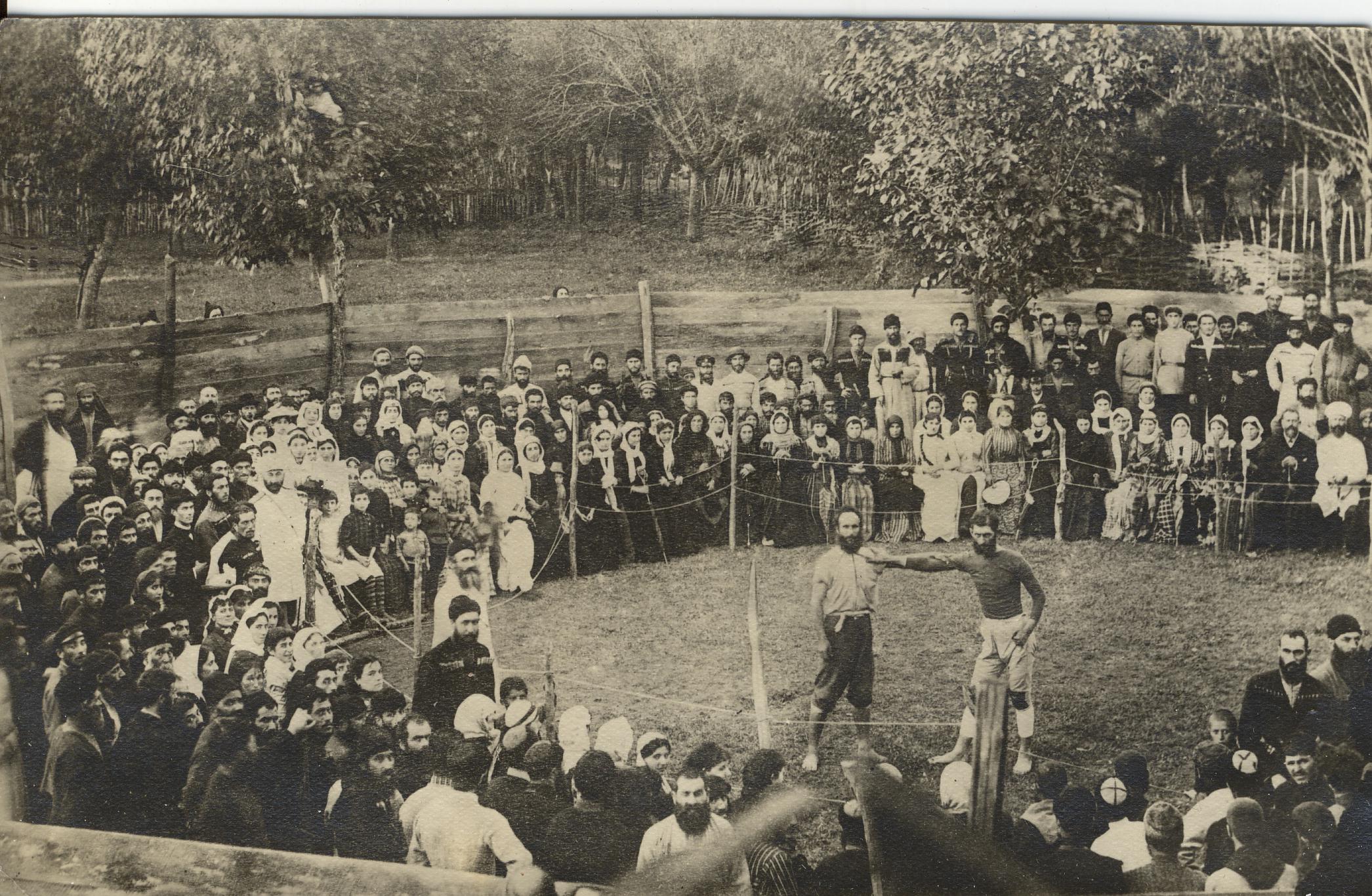
Wrestling in Tbilisi. Early 20th century. Tbilisi Art Palace.
From the History of Wrestling
The precise origins of Georgian wrestling remain unknown; however, its roots reach deep into antiquity and are organically intertwined with the country’s ethnocultural identity.
In ancient Meskheti, much like in Greece, the “Meskhian Games” were held every four years, where feats of strength and valor were tested, including through wrestling.
According to the Roman historian Dio Cassius, in the 1st century AD, the Iberian king Pharasmanes took part in athletic competitions in Rome, where his son Mithridates emerged victorious in wrestling.
Wrestling also occupies a prominent place in ancient legends and oral traditions, most notably in the hero Amirani, who is portrayed as an invincible wrestler.
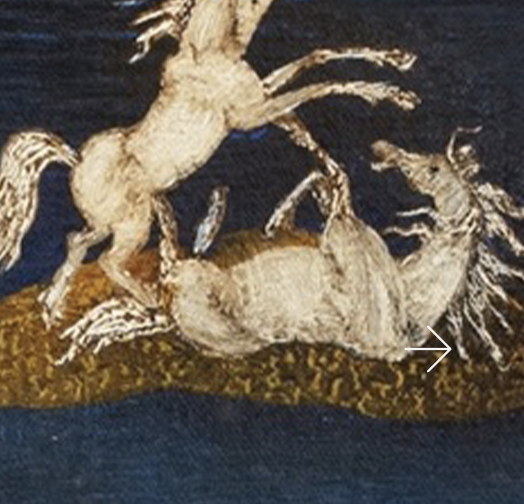
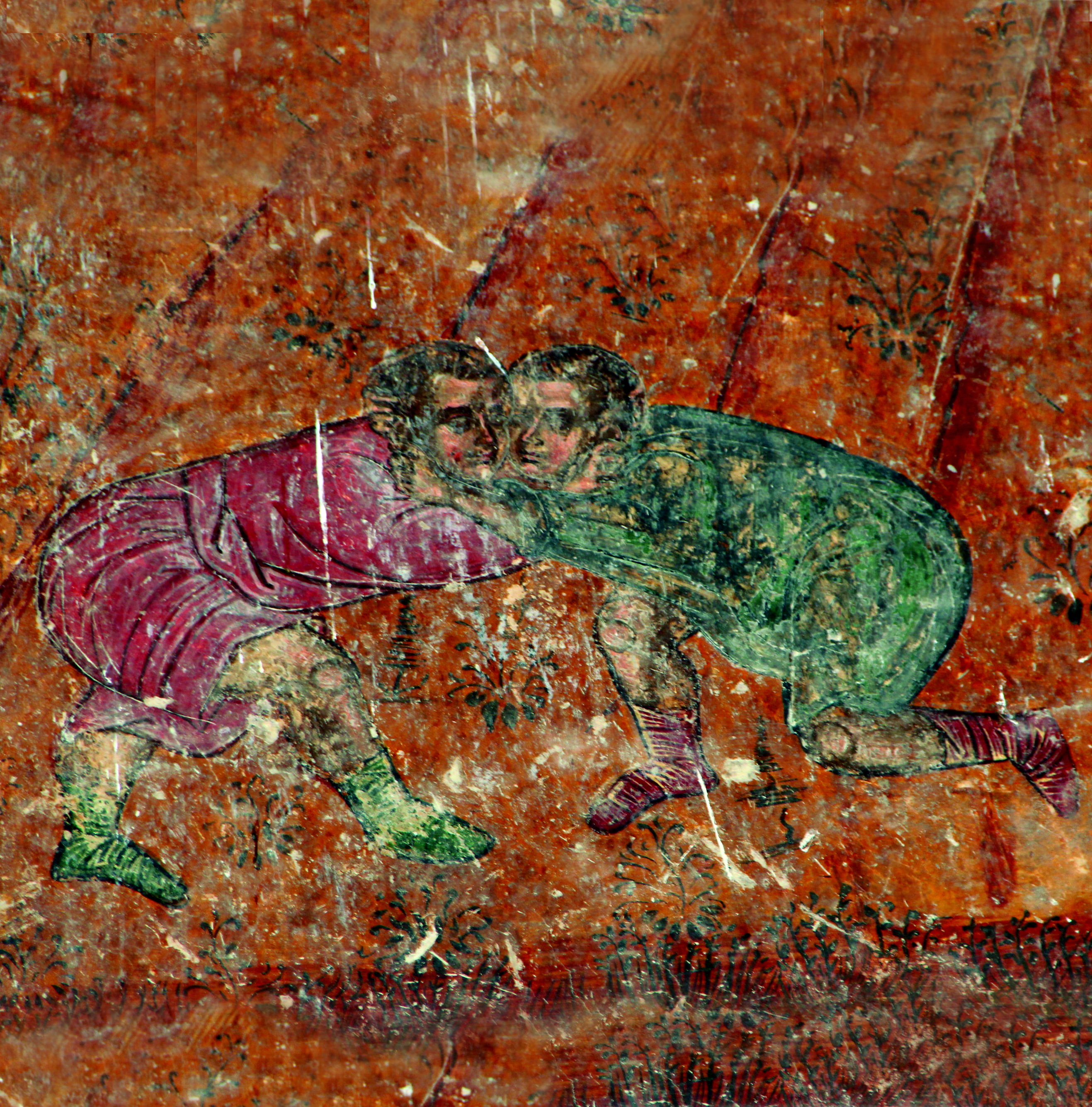
An important visual testament to this tradition appears in an 11th-century fresco in Alaverdi Cathedral. Professor Aleksi Robakidze, claims that this fresco, which depicts two wrestlers, is among the earliest and most reliable visual sources confirming the existence of Georgian wrestling in 11th-century Georgia.
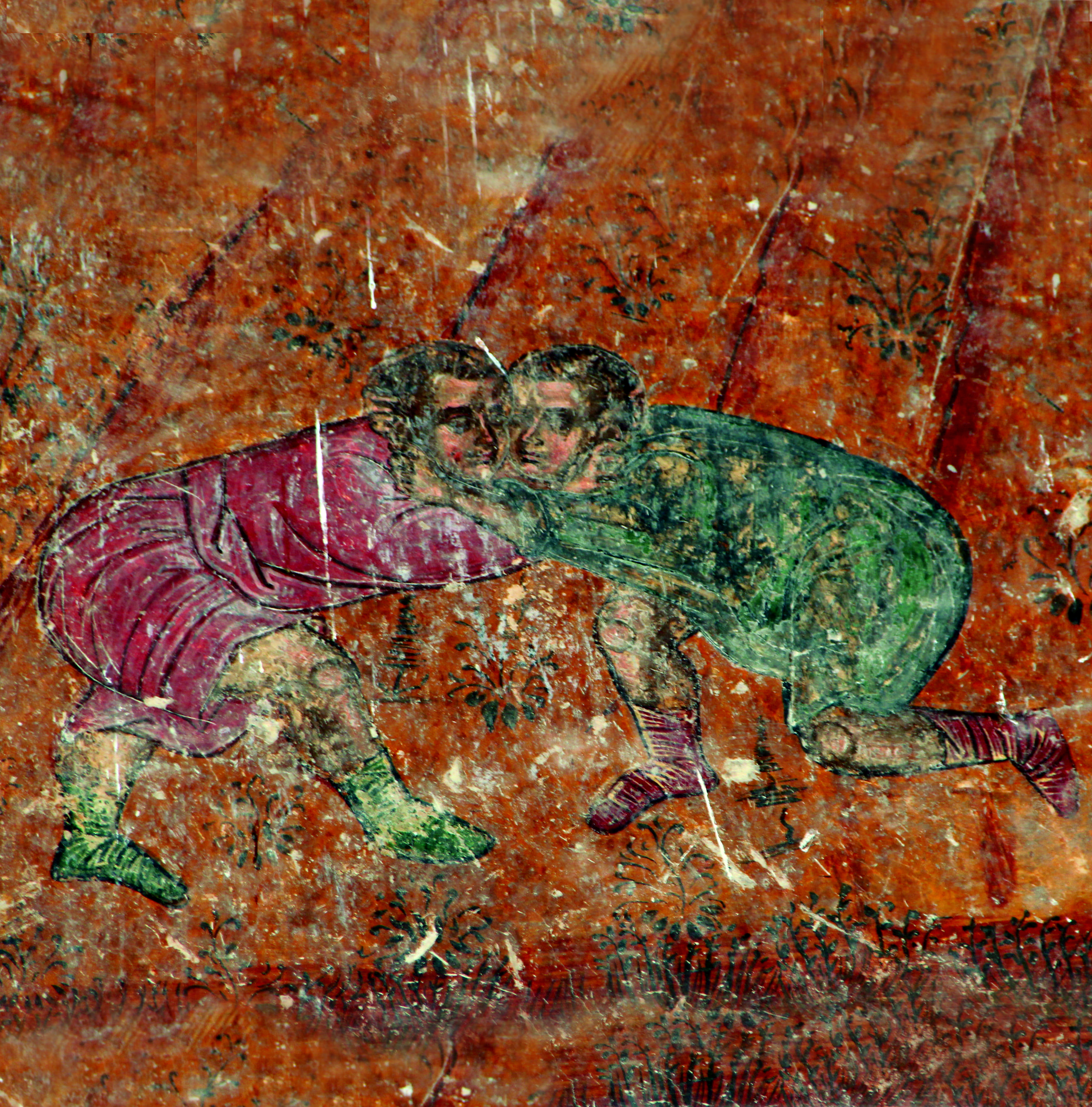
11th-century. Fragment of the Alaverdi Fresco.
Accounts of this ancient national form of combat are preserved in the chronicles of Kartlis Tskhovreba (The Georgian Chronicles). Notable episodes of wrestling are also described in medieval literary works such as Mose Khoneli’s Amiran-Darejaniani and Ioane Shavteli’s Abdulmesiani (12th century). In the heroic and chivalrous ethos reflected in these accounts, the value system underlying Georgian wrestling is shown to have clear and deep historical foundations.
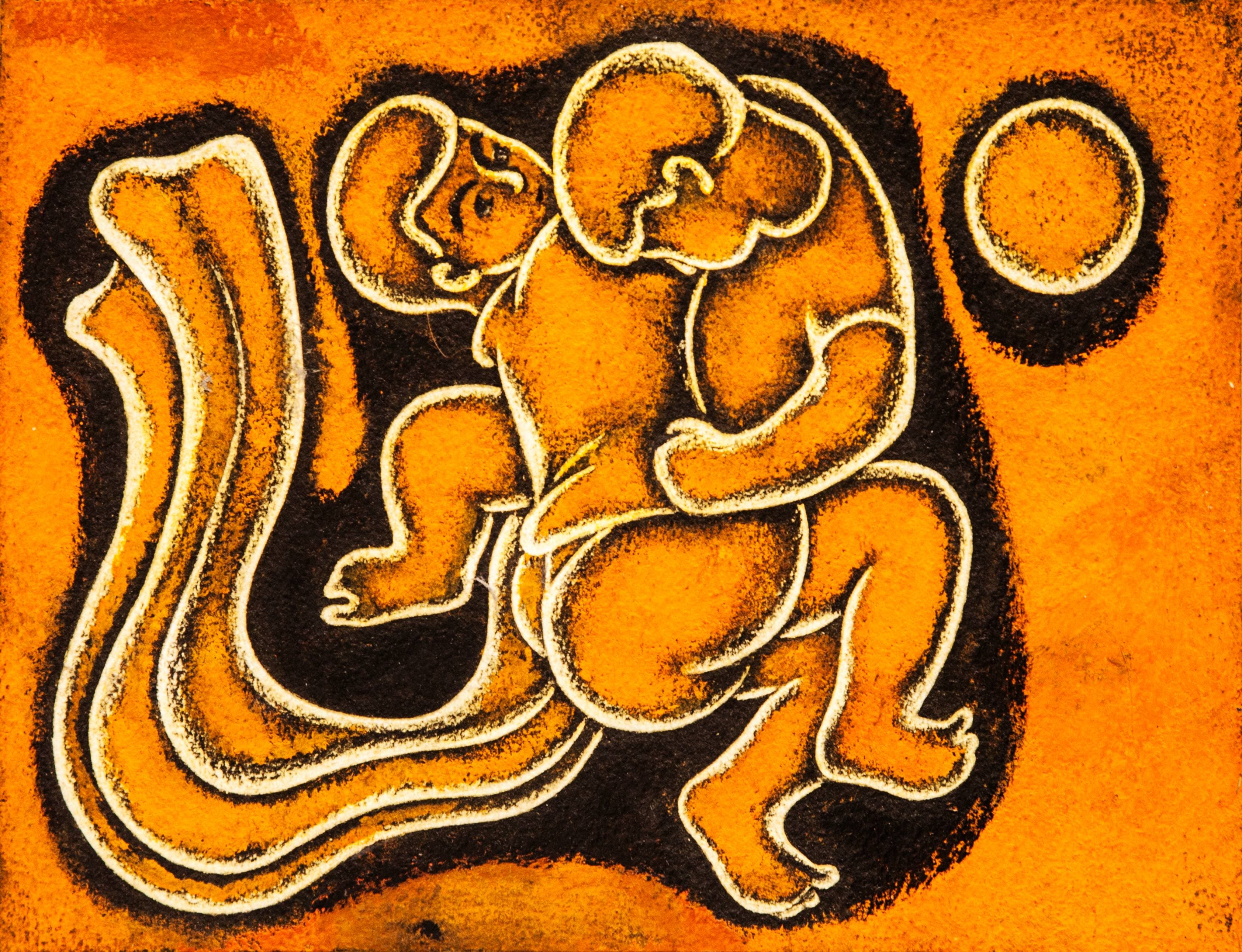
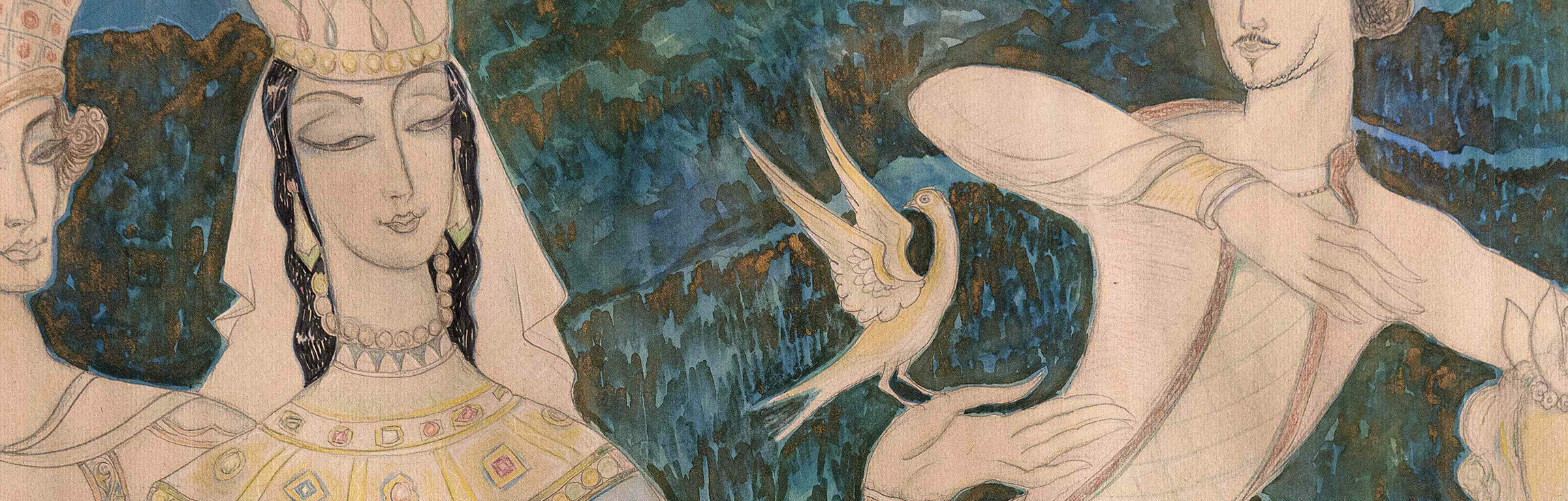
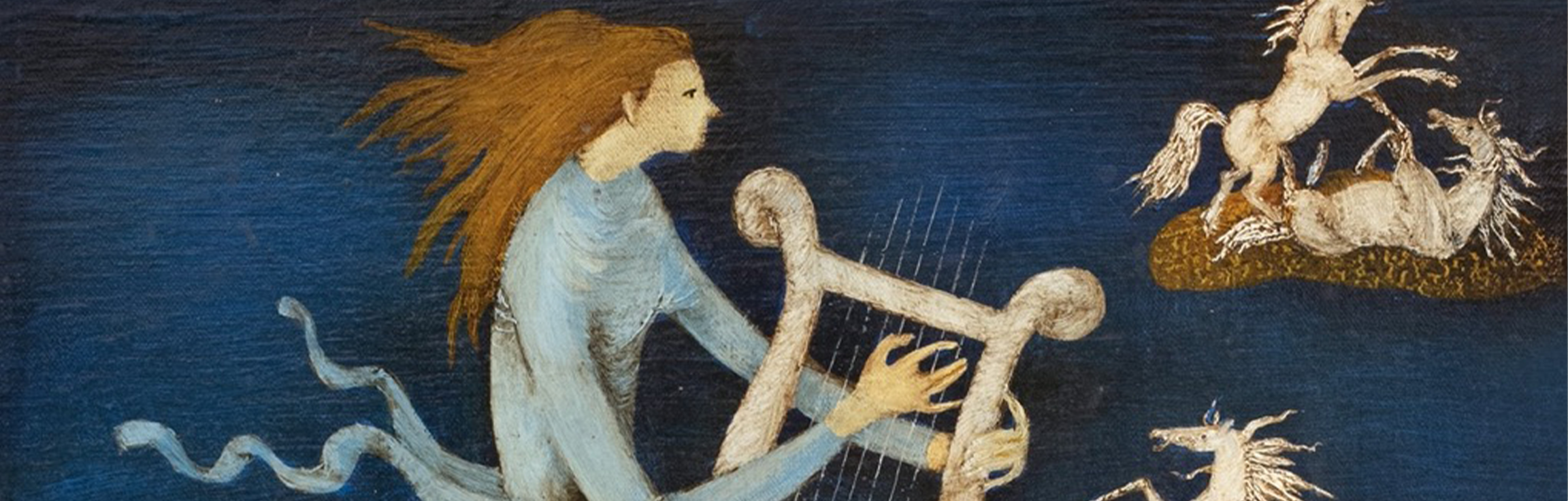
Gulda Kaladze. Illustration for the poem Wrestling. Photo by Sh.Lezhava.
Written sources also record that the Italian monk and traveler Giovanni da Pian del Carpine (c. 1182–1252) described the combat of Georgian wrestlers in the Mongol horde, noting the dramatic circumstances of their victory.
Another episode preserved in collective memory recounts a contest held in Istanbul in 1579, in which the Georgian prince Kvarkvare Jakeli defeated the Sultan’s wrestler.
Prominent wrestlers of the 19th century and later periods, which include David Khizambareli, Kula Gldaneli, Nestor Esebua, Kosta Maisuradze, Sandro Kandelaki, and Kola Kvariani, are heros in numerous folk narratives and literary works.
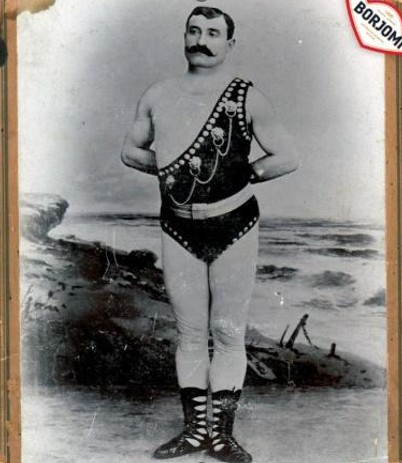
Kula Gldaneli, undefeated wrestler of the early 20th century.
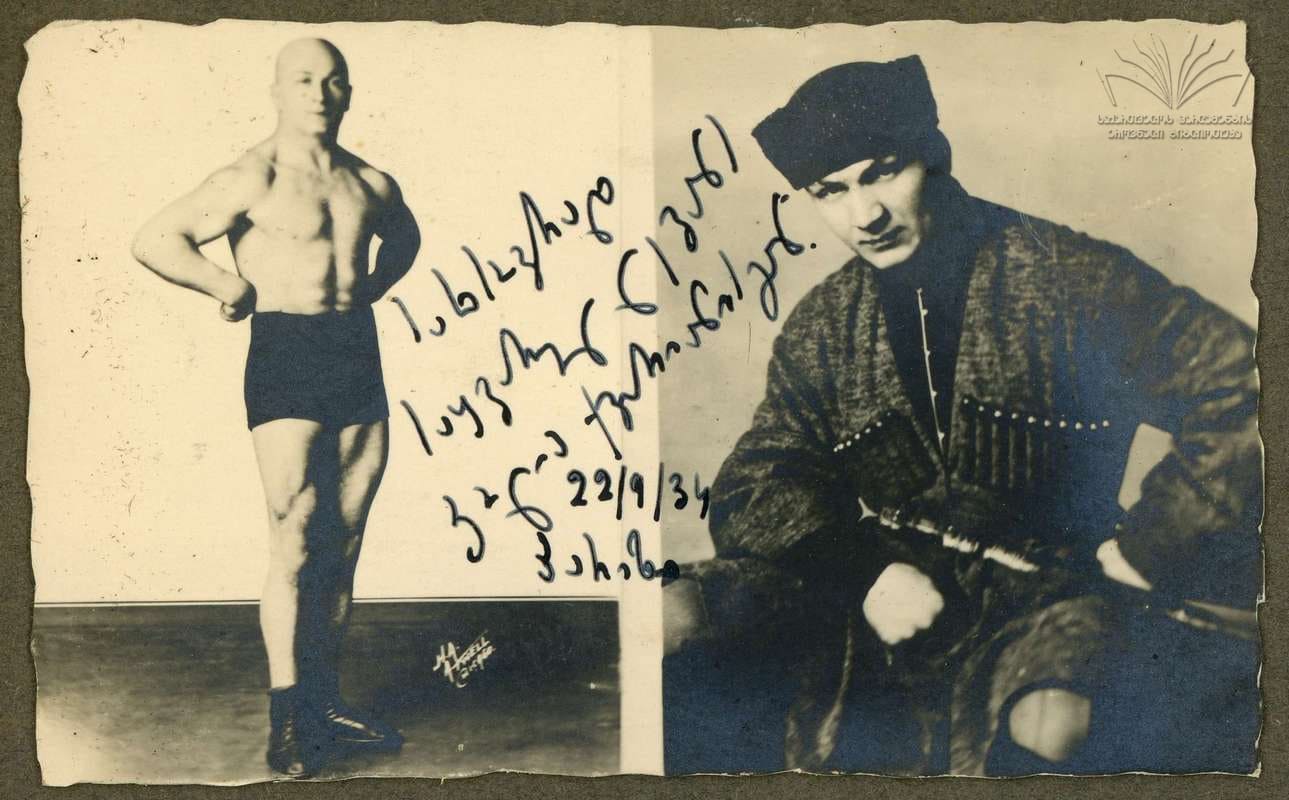
Kolia Kvariani. National Library.
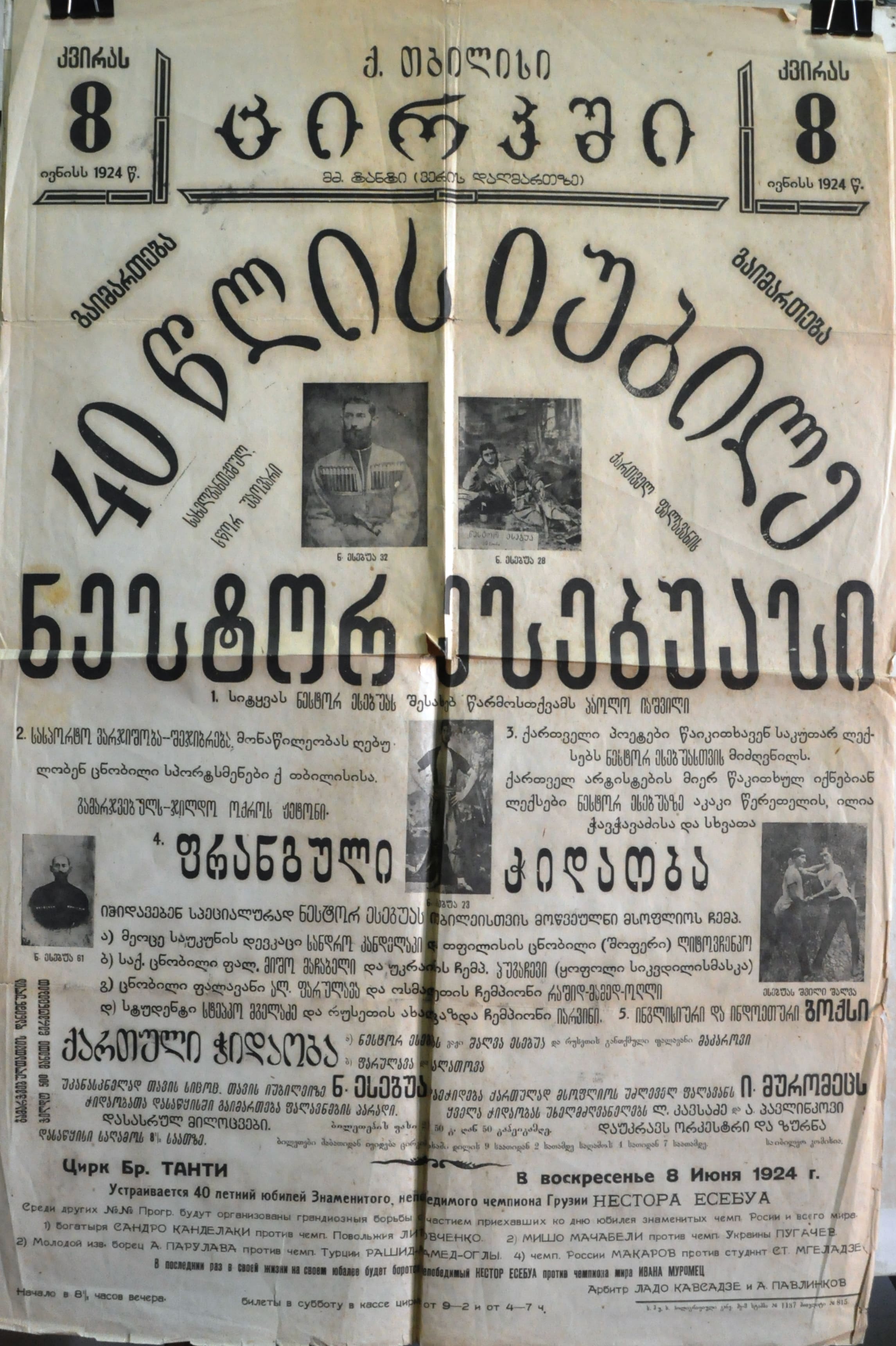
Poster from T. Gogibedashvili's archive.
Wrestler - Knight
The true setting of Georgian wrestling is the village. From early childhood, boys test and affirm their courage through playful bouts of wrestling, and no; village festival or religious celebration is comple without it. In earlier times, every village had its own champion - strong, honorable, and widely respected. He defended not only his personal reputation, but also that of his entire community.
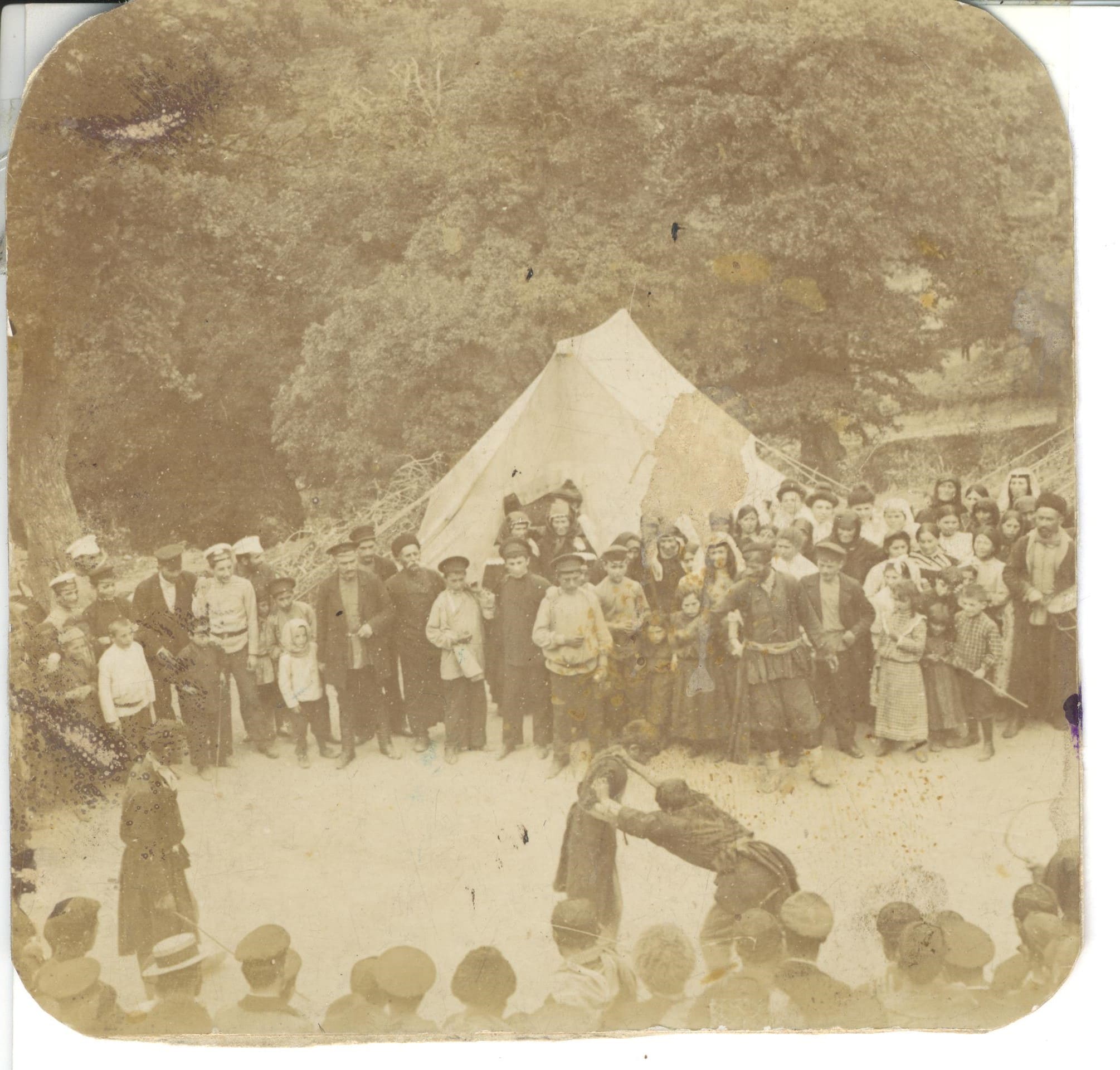
Wrestling in village. 1900s.
It is well documented that up to fifteen distinct forms of wrestling were practiced across different regions of Georgia. These include: the Kartlian-Kakhetian style; the Svan librigiel (belt-gripping wrestling) and libundzgval (group wrestling); the Rachian styles bechdabech (shoulder-to-shoulder) and ghojuri; the Imeretian sabechuri; the Gurian chedoba; Megrelian forms rkineba and mogorda; the Kizikian mklavmobmit (arm-gripping wrestling); Adjarian matekroba; the Mtiuletian styles ighlighora and majura; the Khevsurian moshdamosh (wrestling without the use of legs) and mukasrisa (in which legs were also used); the Ingilo kamar-kamar (belt-to-belt wrestling); and the Pshavian and Meskhetian forms. In addition, there were specialized forms such as mkerdaoba (wrestling without the use of the hands), one-handed wrestling, and blindfolded wrestling.
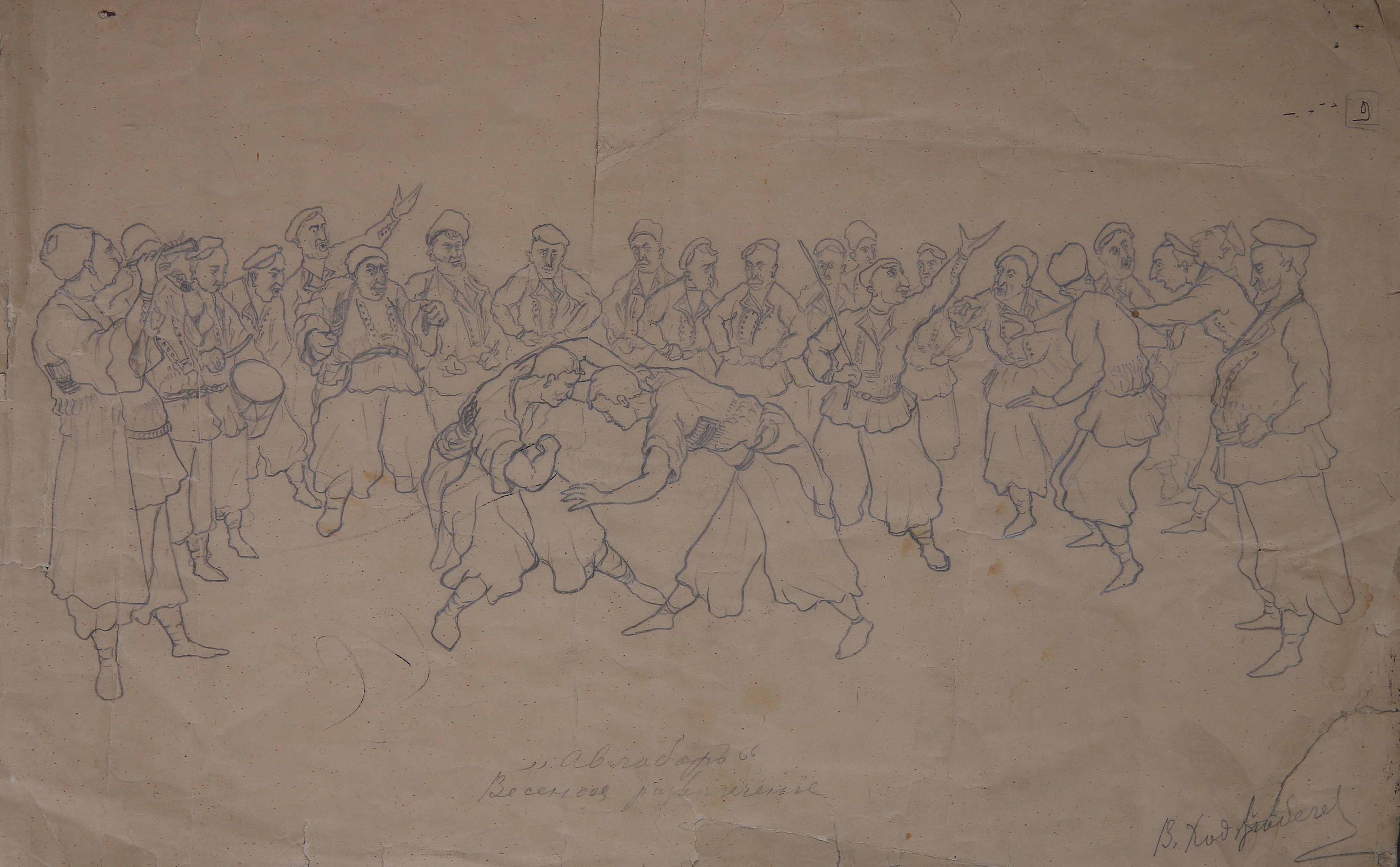
Graphics by Vano Khojabegov. Tbilisi History Museum.
From the 20th century onward, the tradition of wrestling became firmly established in large cities. In Tbilisi, wrestling grounds were located on Mtatsminda, in Didube, in the Italian Garden, in Mushtaid, and on Pikris Gora. Among the most notable figures associated with these venues was Mikitan Babachua, - known as Gola Lezhava, - renowned as a master of Georgian wrestling. Near the Church of St. Peter and Paul, in a local wrestling circle, Vano Abuladze, known as “Kambechua,” was a frequent competitor. In the Kharpukhi district, a wrestling ground known as “Sakinule” (“the Ice Ground”) hosted performances by the celebrated “Mukha Kola” (Niko Nargizashvili), among others.
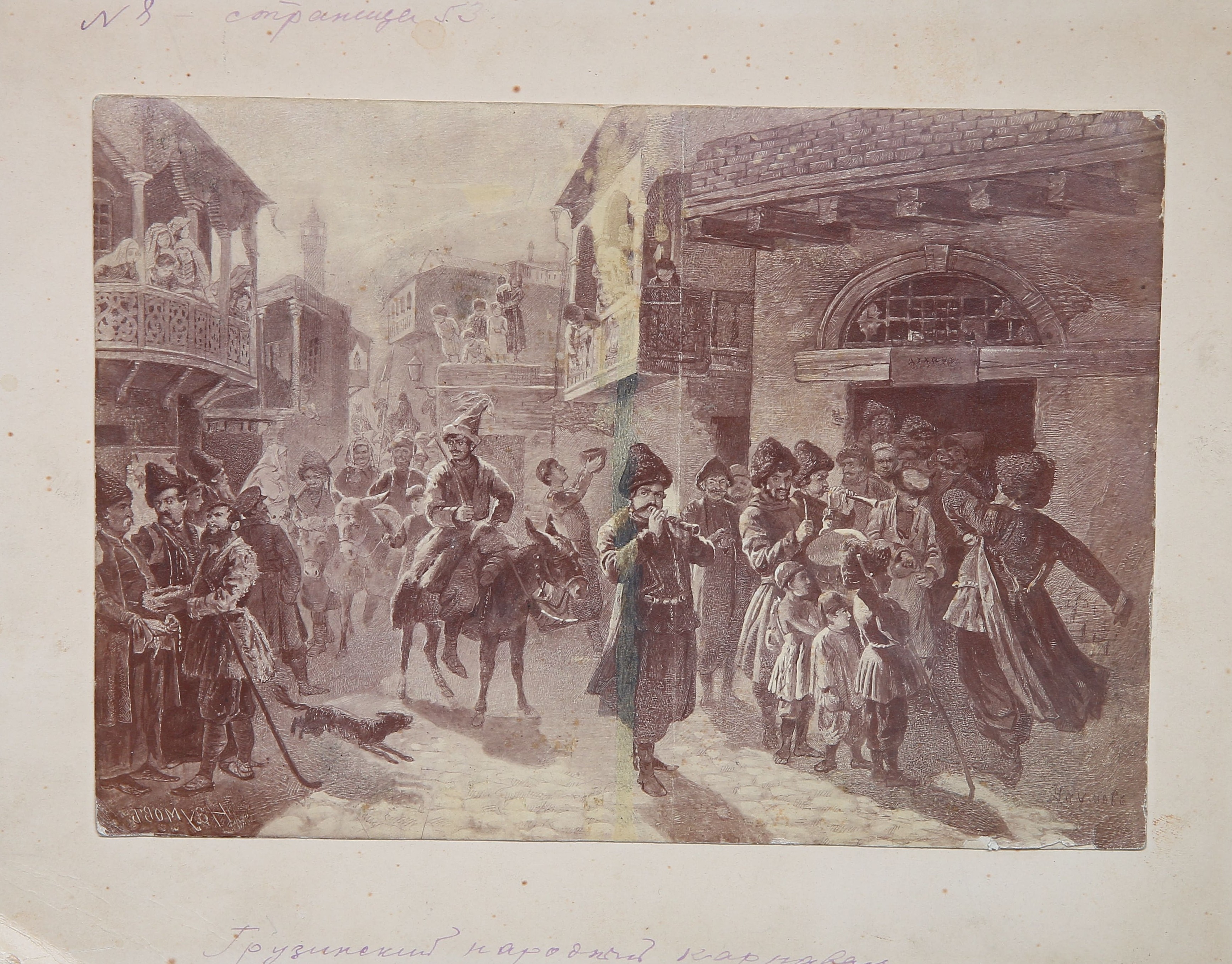
Berikaoba. (Berikaoba is an improvised masqueraded folk theater in Tbilisi). Part of the painting by Artist Namurov. Tbilisi History Museum.
Since early times, Georgian wrestling has been characterized as a chivalrous sportic ethos. Fleeing the arena, engaging a fallen opponent, or deliberately attempting to injure one’s rival is strictly forbidden. The contest is direct and open: hand meets hand, foot meets foot, hip meets hip. Deceptive or cunning tactics are excluded, and it is likewise impermissible to press down on or roll over a fallen opponent.
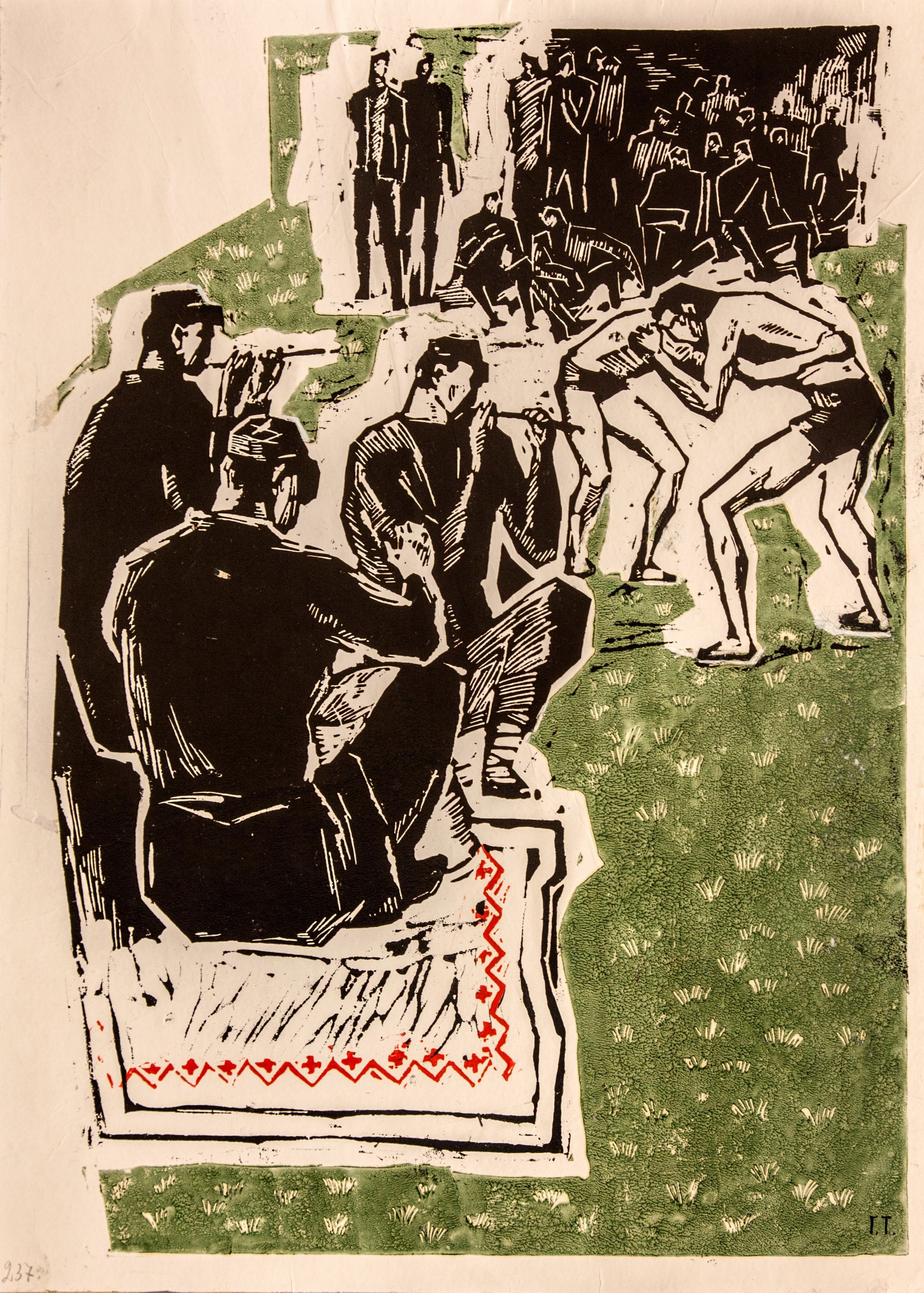
Givi Tushiashvili. Wrestling. Colored linocut. Photo by Sh.Lezhava.
Traditionally, bouts are held outdoors, within a ring formed by spectators and covered with grass, sawdust, or hay. The beginning of the contest is marked by music —typically the eastern zurna and the Georgian drum —whose rhythm accompanies and guides the wrestlers’ movements. For this reason, Georgian wrestling often resembles a form of dance.
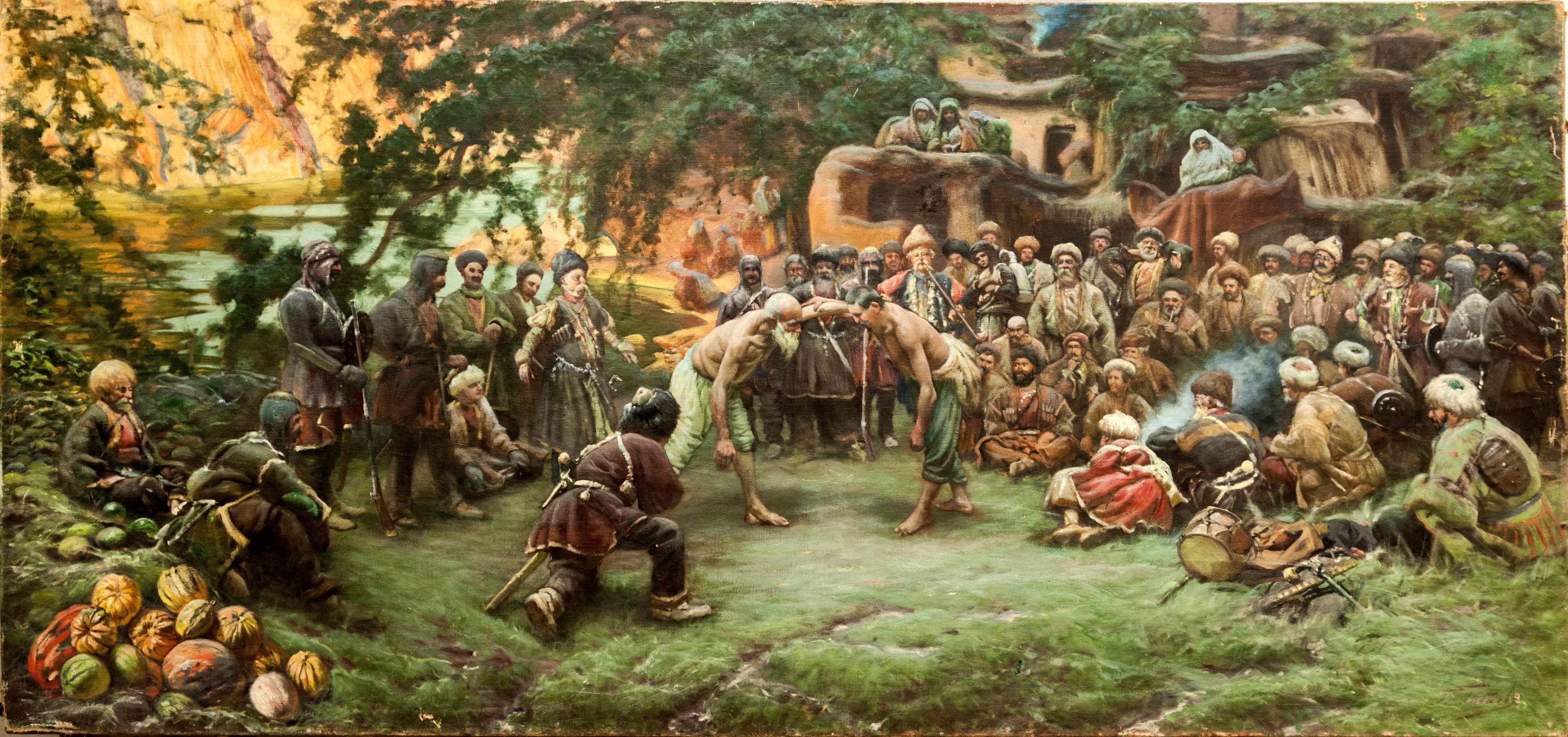
Gigo Gabashvili. Wrestling. Oil on Canvas. 1900s. Photo by V.Kenia.
Classical compositions by Revaz Lagidze, Sulkhan Tsintsadze, and Otar Taktakishvili, based on traditional wrestling musical themes, further prove that Georgian wrestling is not merely a sport, but a broader cultural phenomenon.
Identity and Cultural Heritage
When a wrestler steps into the circle, straightens his chokha, fastens his belt, and starts moving to the the music, he is doing more than preparing to compete; he is carrying forward the traditions of centuries.
Georgian wrestling is, above all, a struggle for dignity. It serves as a way to showcase a person’s creative talent in, a competition marked by diversity, creativity, skills, and respect for one’s opponent. It is a living cultural memory; a form of national identity that endures through time and speaks to new generations in the language of honour.
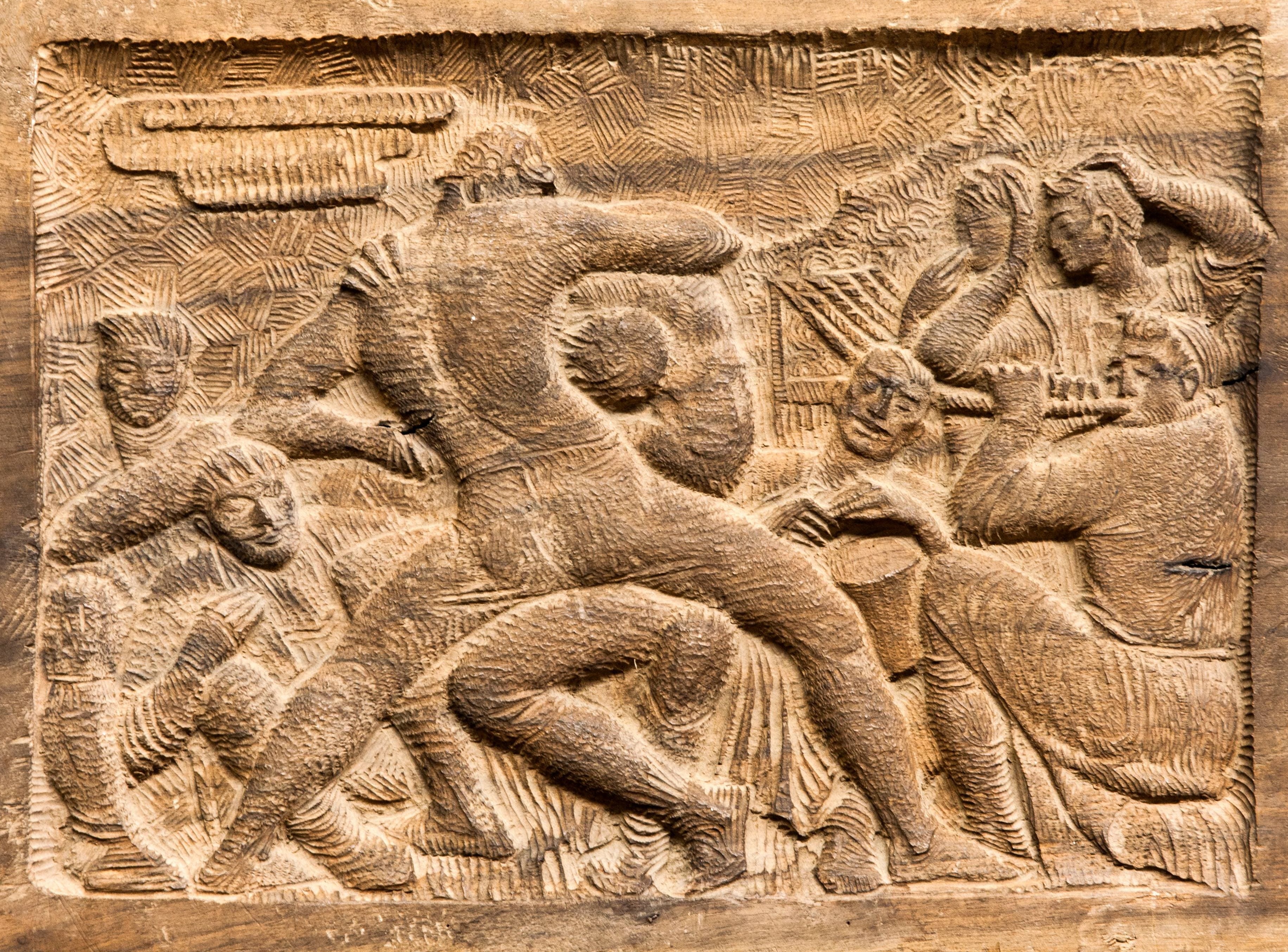
Eelguja Amashukeli. Wrestling. Relief, wood. Photo by Sh.Lezhava.
In the modern world, where cultural boundaries are gradually dissolving and national distinctions are sometimes lost in the tide of global uniformity, Georgian wrestling reminds us that tradition can coexist harmoniously with modernity. It is not merely a sport, but a system of values, a school of chivalric ethics, and a living cultural memory. For this reason, its international recognition is not simply a formal status, but an affirmation of national identity: —a continuation of history into the future.