In
2001, an exceptionally valuable Georgian artefact, which had been considered
lost since 1991, unexpectedly appeared at a Christie’s auction in Geneva. This
outstanding ivory work, known as the Okoni Triptych Icon, had disappeared from
the Tskhinvali Museum. At that time, Georgian jurisdiction no longer extended
over the territory, and the loss was not officially reported by the museum. For
a considerable period thereafter, the triptych remained effectively ‘detained’
in the secure storage facilities of the Palace of Justice in Geneva. Under the
1959 European Convention on Mutual Assistance in Criminal Matters, the Okoni
Triptych Icon was to be returned to the country from which it had been
unlawfully removed and to which it rightfully belonged. However, its return to
its homeland was preceded by numerous difficulties and obstacles. Only after
overcoming these challenges did this remarkable monument finally take its place
in the Shalva Amiranashvili Museum of Fine Arts in Tbilisi.
Several
monuments are known under the name ‘Okoni Icon’. Consequently, it proved
challenging to confirm the identity of this particular work. According to
Prince Vakhushti Bagrationi, the Byzantine wife of King Bagrat IV, Helen,
brought the icon to Georgia as part of her dowry, together with other
treasures: ‘She brought the Nail of the Lord, the Okoni Icon, and many
treasures as a dowry’. While some scholars support this view (Uvarova, Florensky, Goldschmidt,
Weitzmann, Mishakova), others have identified the work either
as an icon of the Mother of God
(Bakradze) or as an icon of the Crucifixion (Taqaishvili). It is generally thought to have been made in Georgia, although
its style clearly reflects Byzantine artistic principles.
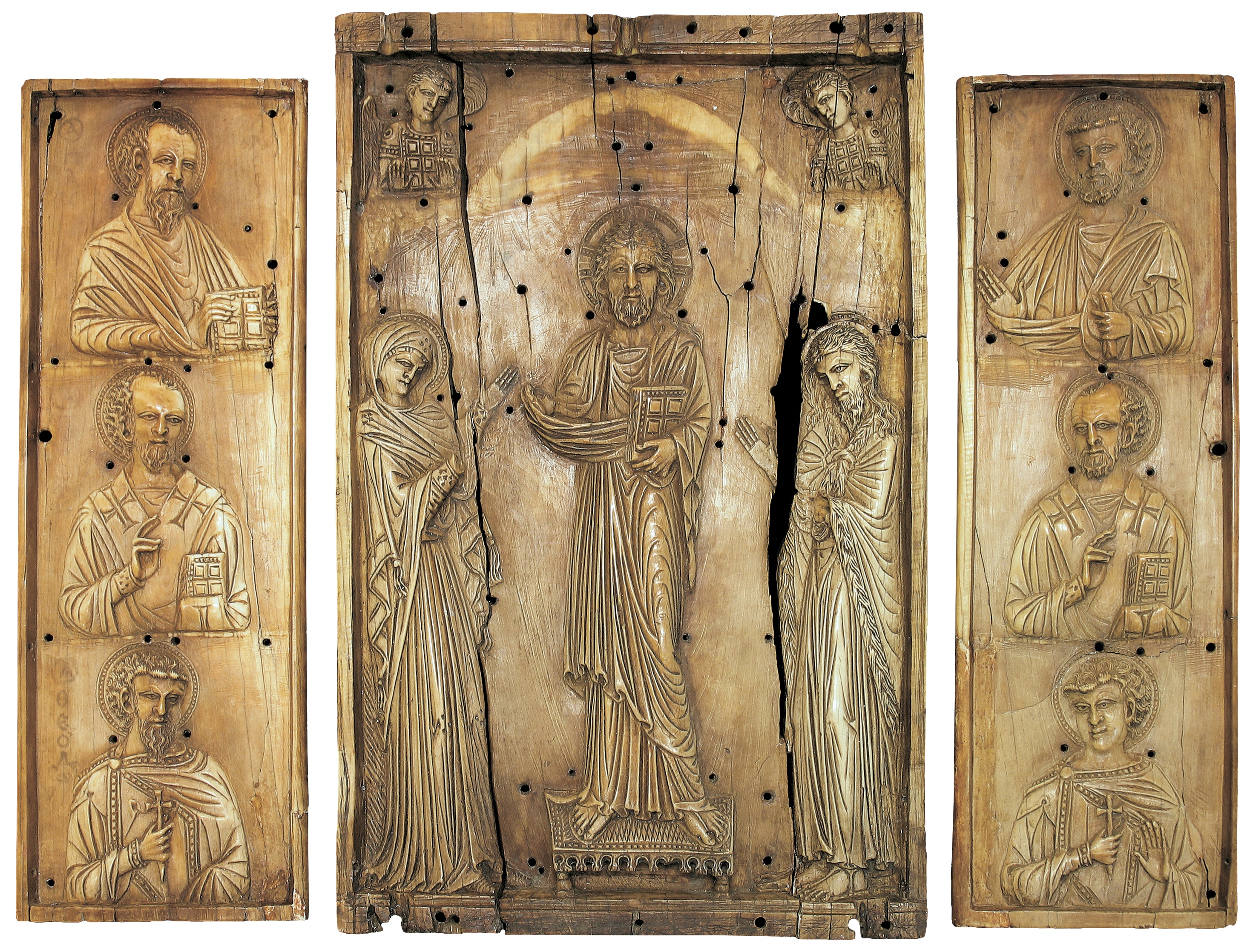
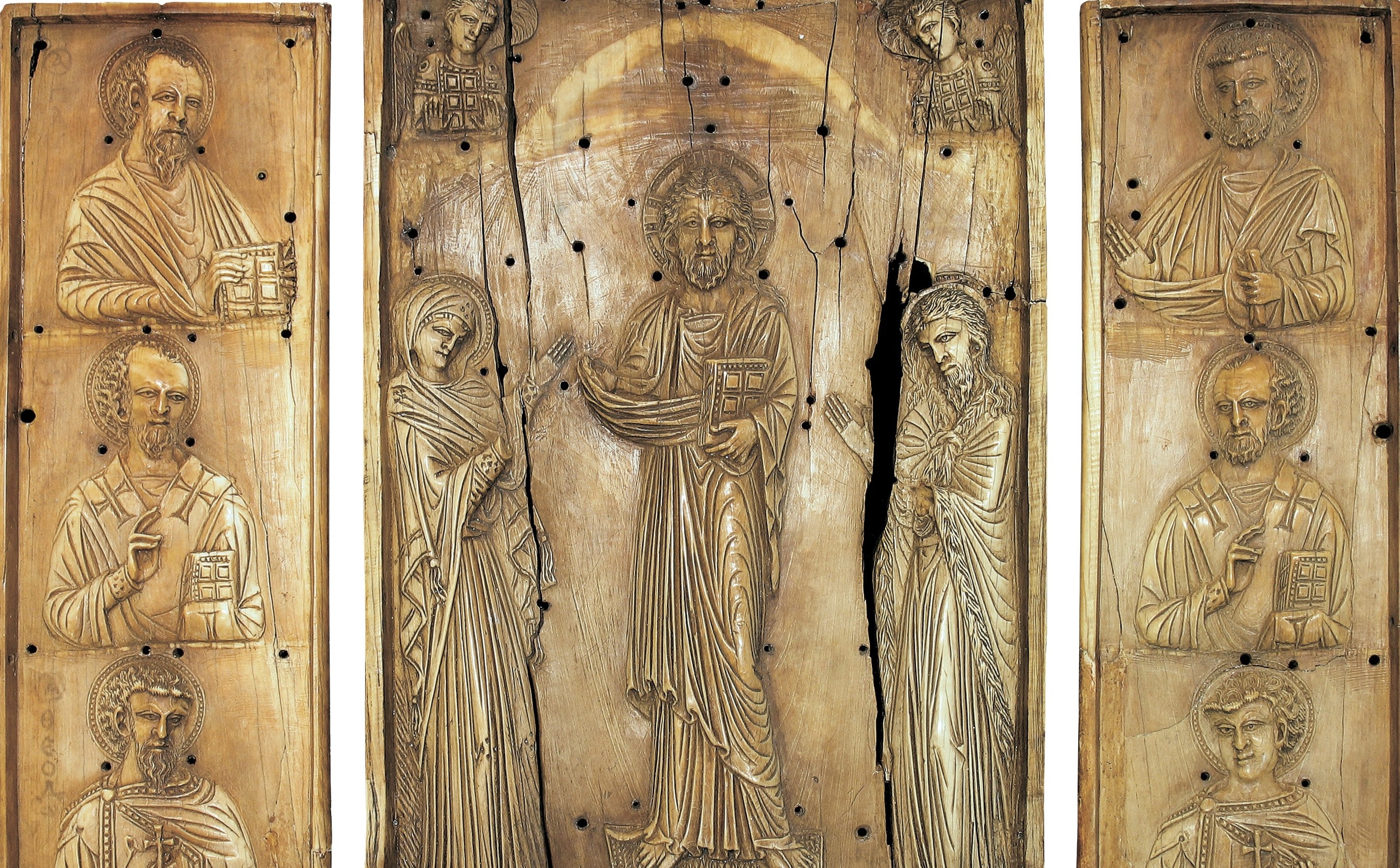
Okoni Triptych Icon
When
and how this magnificent example of Byzantine art came to Georgia, specifically
to the village of Okona in the Znauri district, remains uncertain. Uvarova
encountered it in the newly built church of Okona. According to the information
she gathered, the icon was removed from Okona by Lezgin raiders, later came
into the possession of Prince Tsereteli, and was eventually returned to the
Okona Church. In 1924, the triptych was transferred from there to the
Tskhinvali Museum. In 1984, the icon was studied in situ and
photographically documented. At that time, it became the subject of scholarly
research by Leila Khuskivadze. The outstanding photographs taken by Otar
Tskvitinidze provide invaluable visual evidence of the icon’s condition prior
to its theft. It is therefore clear that the icon in its present state does not
fully represent the monument’s original appearance. In the seventeenth century,
it was enclosed in a silver case adorned with three elongated crosses. The
space beneath the arms of the central cross was once decorated with an
Asomtavruli inscription: ‘Okoni Icon, have mercy upon Catholicos Eudaemon, the unworthy. Amen.’
The
Catholicos Eudaemon mentioned in this inscription, identified as Eudaemon
Diasamidze, who served during the reign of Teimuraz I (1630–1642), is likely to
have commissioned the covering of the triptych with thin gilded plates and its
embellishment with precious stones. The decoration included one large sard,
twenty-five garnets, one turquoise, and three imitations.
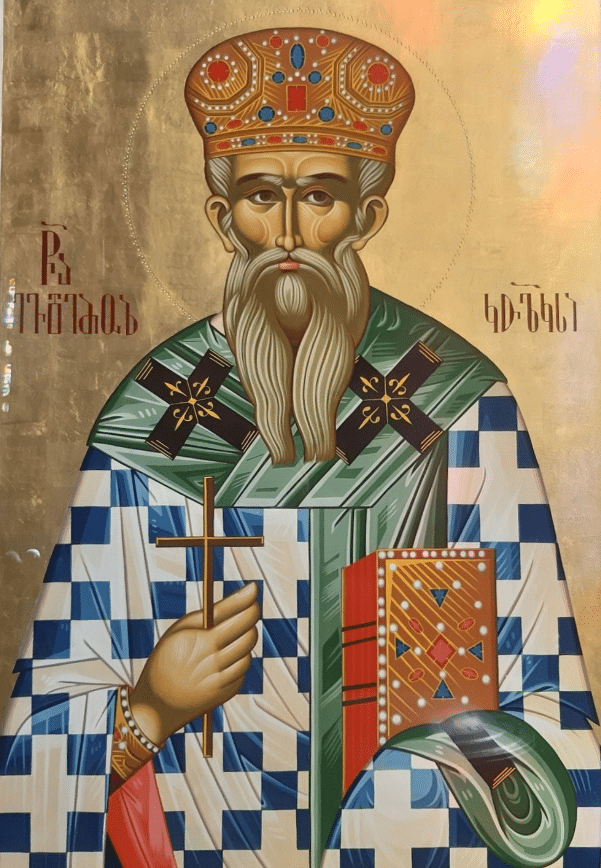
Eudaemon I Diasamidze, The Catholicos Patriarch of Georgia in 1632-1642
It seems that the
condition of the icon had deteriorated significantly by that time, and the
silver case was most likely designed to protect it, while the gilded plates
were intended to conceal areas of damage. However, the nails used to set the
stones caused additional harm to the rare central ivory plate. The subsequent
forcible removal of the silver case and gilded plates by thieves inflicted
further damage. However, it also facilitated the recovery of the icon’s earlier
appearance and enabled a closer examination of its details. All signs of
deterioration were thoroughly documented in Geneva by Elene Kavlelishvili, an experienced
curator of the Georgian Museum of Fine Arts. Today, the icon has been freed of
these later additions and is presented in a form closer to its earlier state,
allowing for further analysis. At the same time, the case appears to be the
only effective means of structurally reinforcing the triptych. For this reason,
at a solemn ceremony on 26 May 2004, marking the return of the treasured work
to Georgia after its long journey, His Holiness and Beatitude
Catholicos-Patriarch Ilia II expressed the view that a protective case should
be restored to the icon.
What distinguishes this monument as a piece of art,
and why does it occupy such a significant place in global cultural heritage?
The
Okoni Triptych belongs to a distinct group of tenth-century ivory triptychs,
characterised by a Deesis composition in the central panel and figures of
saints and pedestal crosses on the wings. Among these works, the Okoni Triptych
appears to be the most refined, distinguished not only by its exceptional
quality, delicacy, and dimensions. Free from rigidity and schematic treatment,
the triptych is more closely aligned with the refined ivories of the so-called
Romanos group. Its artistic merit is evident even in the exquisitely carved
ivory crosses.
The
Okoni icon is also remarkable in terms of its dimensions: it measures 23 cm in
height, whereas similar triptychs, such as those in Hildesheim, London, and New
York, measure only 14.5 or 15.5 cm. Its width when closed is 14.5 cm, compared
with 10.32 cm, 12 cm, and 13 cm in the aforementioned examples. The figure of
Christ measures 15.5 cm in height (excluding the footstool), whereas in the
London and New York triptychs, the figure occupies the full height of the
central panel.
Examination
of the icon after the removal of later additions confirmed the assumption that
the reverse side of the central part of the ivory was originally plain; its
surface reveals the natural oval structure of the ivory layers. The crosses
carved on the backs of the wings are repeated on the embossed case. The master
engraver likewise reproduced the form of the ivory pedestals with steps,
rendering seven steps on the right wing and six on the left. The composition is
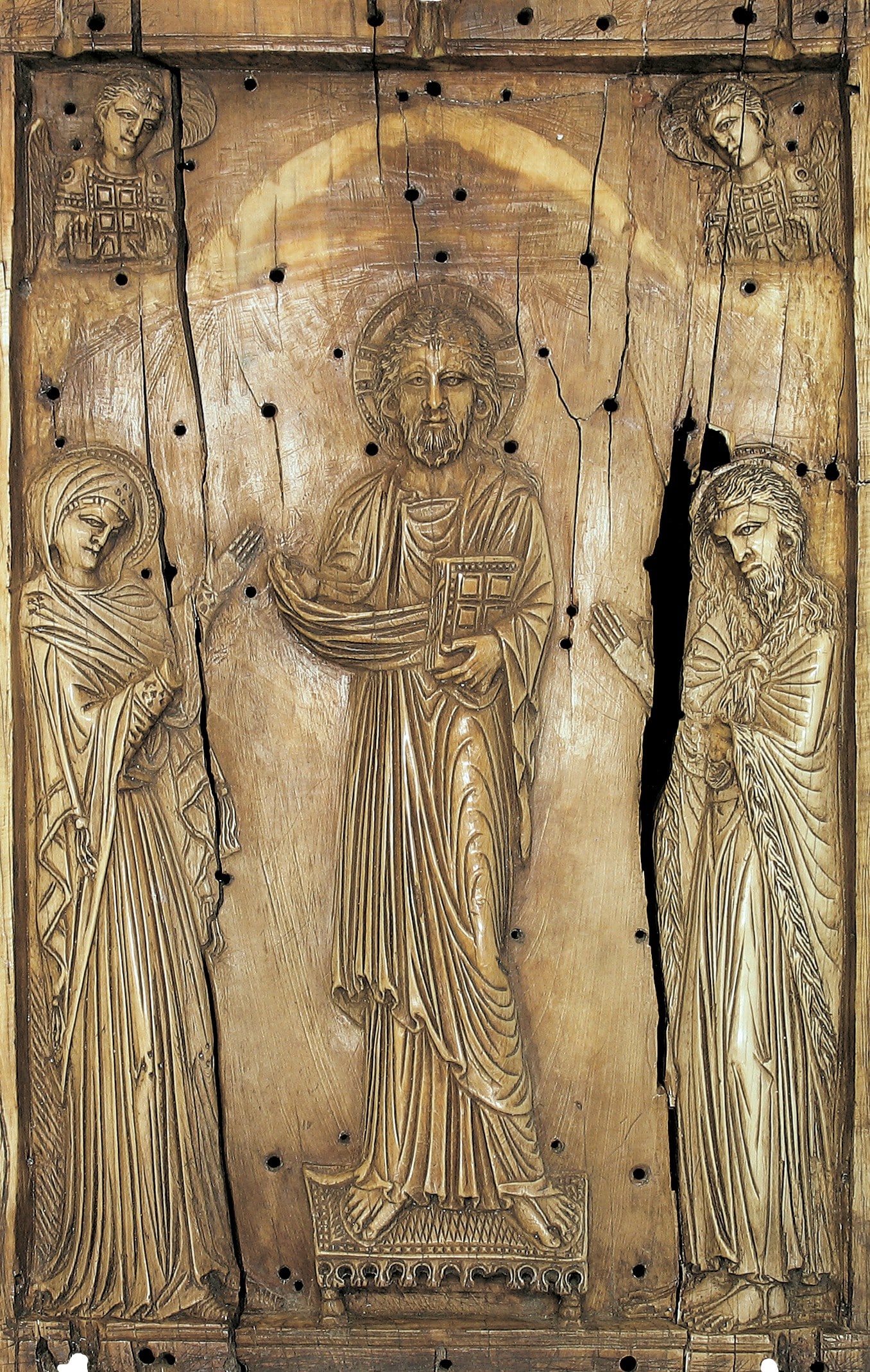
well balanced. The original Deesis composition appears to have included a
baldachin, a common feature of triptychs of the period. Typologically, it is
similar to the baldachin structures of well-known triptychs in London and New
York. Giorgi Chubinashvili suggested that the Okoni baldachin represents a
‘Hellenistic, baroque variant … more closely associated with Byzantine artistic
traditions’. Its function was to frame the sacred image, providing greater
visual stability and monumentality. The icon no longer retains its baldachin,
and the right-hand sections depicting Saints Paul, John, and Theodore.
.jpg)
Deesis composition, Central Part of Okoni Triptych
The
removal of the silver plates from the front of the Okoni icon revealed
identifying inscriptions accompanying the figures. The Greek texts are executed
in a dark brown pigment typical of ivory carvings of that period. In the
central panel, only part of Christ’s monogram (IC) survives, placed to the left
of the Saviour’s head, where His halo ends. The corresponding letters on the
right are no longer legible. The half-length saints depicted on the wings were
likewise originally identified by painted captions. Each inscription began in
the upper corner with the word ΑΓΙΟΣ (Saint), enclosed within a circular frame.
Today, the figure of St George is without a surviving inscription, while only
the letter C remains beside St Nicholas. A complete inscription is preserved
solely for St Paul; the others have lost their final letters. On the left wing,
the names of John the Theologian and Theodore are no longer readable; on the
right, that of Peter has likewise faded.
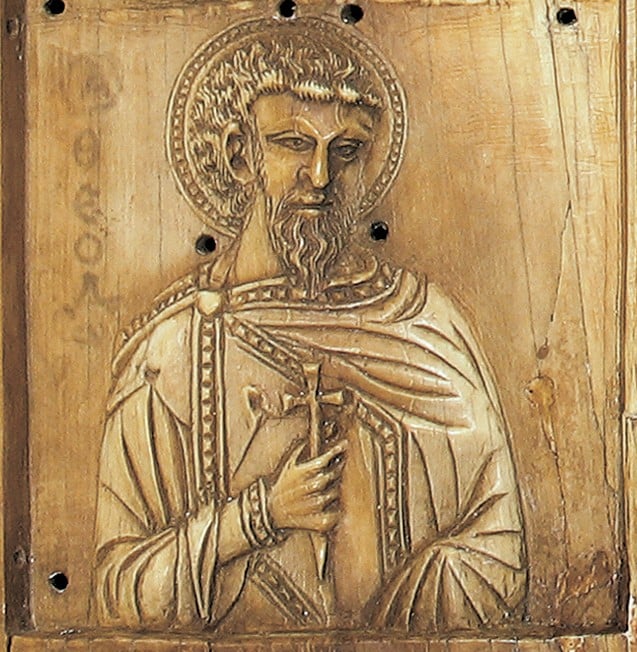
Greek Inscription for St. Paul
On
the wings of the triptych, a dividing line between the half-figures of the
saints is rhythmically intersected by knots. The interaction between the plain
background and the images introduces a sense of volume that was previously
obscured by the silver plates.
.jpg)
The Right Wing of Ttiptych. Saints Paul, John and Theodore
The
influence of antique forms is evident in the elegant execution of the figures,
and in the refined, naturalistic treatment of each detail. To depict the
wrinkles of the saints, the master applies a colouristic technique: the
foreheads of Saint John and Saint Nicholas are covered with warm brown, with
light yellow wrinkles delicately drawn, while golden-yellow highlights shine
through the saints’ curls.
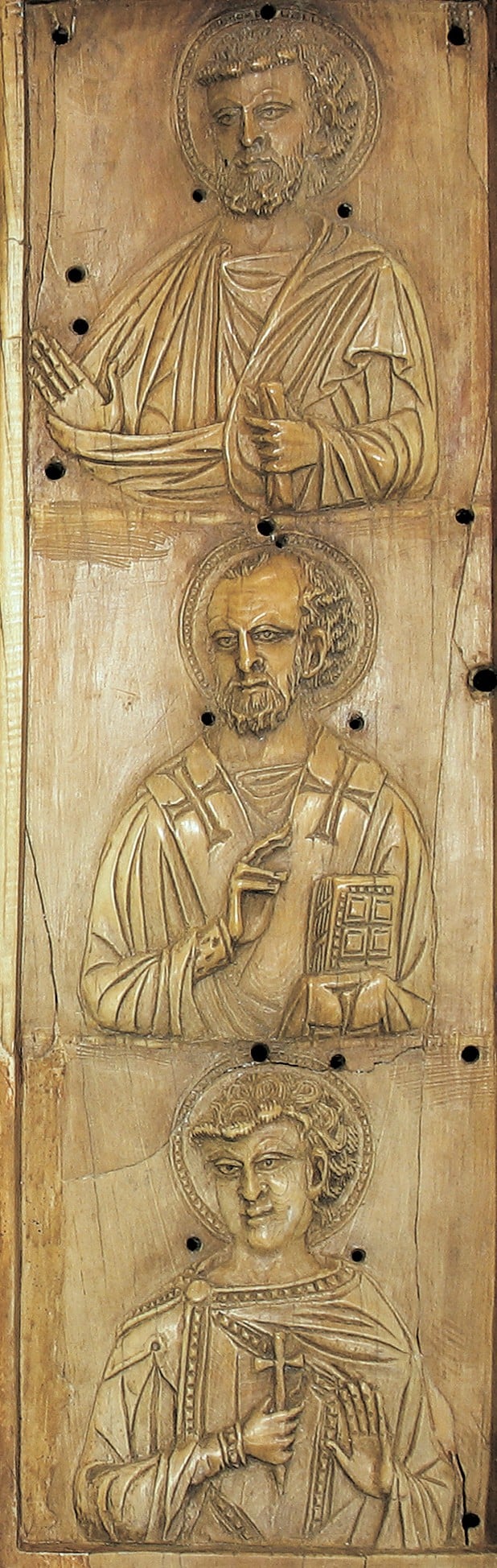
The Left wing of Triptych. Saints George, Nicholas and Peter
The
gilding of the Okoni icon is not exceptional, being comparable to the so-called
Racha Triptych of Georgian origin, also dating to the tenth century. It is
likely that the ivory of the Okoni icon originally possessed a more yellowish
hue.
Of
particular significance is the fact that the Okoni Triptych has survived
intact, with all its constituent elements, whereas other works of the same
group are preserved only in fragmentary or incomplete condition. The hinges
connecting the central panel to the wings have likewise been preserved, as in
the well-known triptychs of Harbaville and the Vatican.
The
style of the Okoni Triptych reflects the artistic tendencies of Byzantine ivory
carving of the period. Although traces of ancient Hellenistic illusionism are
discernible, the triptych demonstrates a decisive transformation of form that
marks it as distinctly medieval. This shift is expressed above all in the
dematerialisation of the figures and the heightened spiritualisation of the
images.