The work of the late 19th- to early
20th-century self-taught Georgian artist Niko Pirosmanashvili is among the
jewels of Georgian cultural heritage. On one hand, Pirosmanashvili's legacy
reflects his unique inborn talent, individual mastery and artistic individuality,
while on the other his art is most often considered among the best expressions
of the Georgian national aesthetic identity and its continuous artistic
traditions. Furthermore, though being undoubtedly traditional,
Pirosmanashvili's works and his means of expression are at the same time strikingly modern. All
these qualities together determine the importance and special place of Pirosmani’s art in the history of
Georgian culture.
The question of what precisely
determines Pirosmani's affiliation with the Georgian visual language, and what
can be identified as the immediate pictorial sources of his work, nonetheless
remains in need of more systematic analysis. In this regard both the
centuries-old traditions of medieval Georgian art (and the pre-Christian
archetypes from which they partially derive), and the diverse phenomena of the
contemporaneous visual culture warrant equal consideration.
A brief glance at Pirosmanashvili's
pictures of various genres is enough to demonstrate that the artist returns
time and again to the same themes, "canonical" subjects, schemes and attributes.
His portraits, feast scenes, animals, rural life scenes, so-called
"epics" (narrative folk-festival compositions), and still lifes all
have their peculiar "iconographic scheme," compositional alignment
and accompanying attributes — similarly to medieval Christian art, where every
scene and image, owing to its sacred significance, conformed to a strictly
defined canon of representation.
It is especially noteworthy that
Pirosmanashvili's painting abounds in motifs which appear to derive from
medieval "prototypes" — a large part of them being ancient, local
archetypes
going back to the pre-Christian era.
The linkage in terms of iconographic
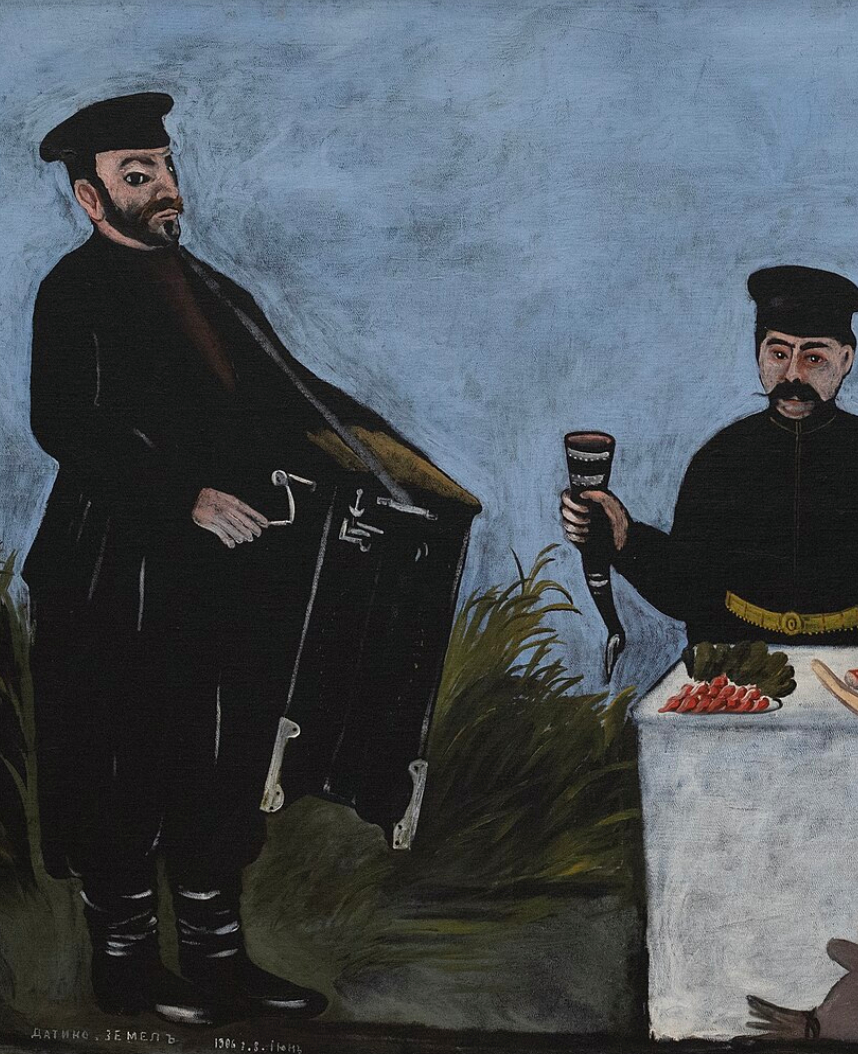
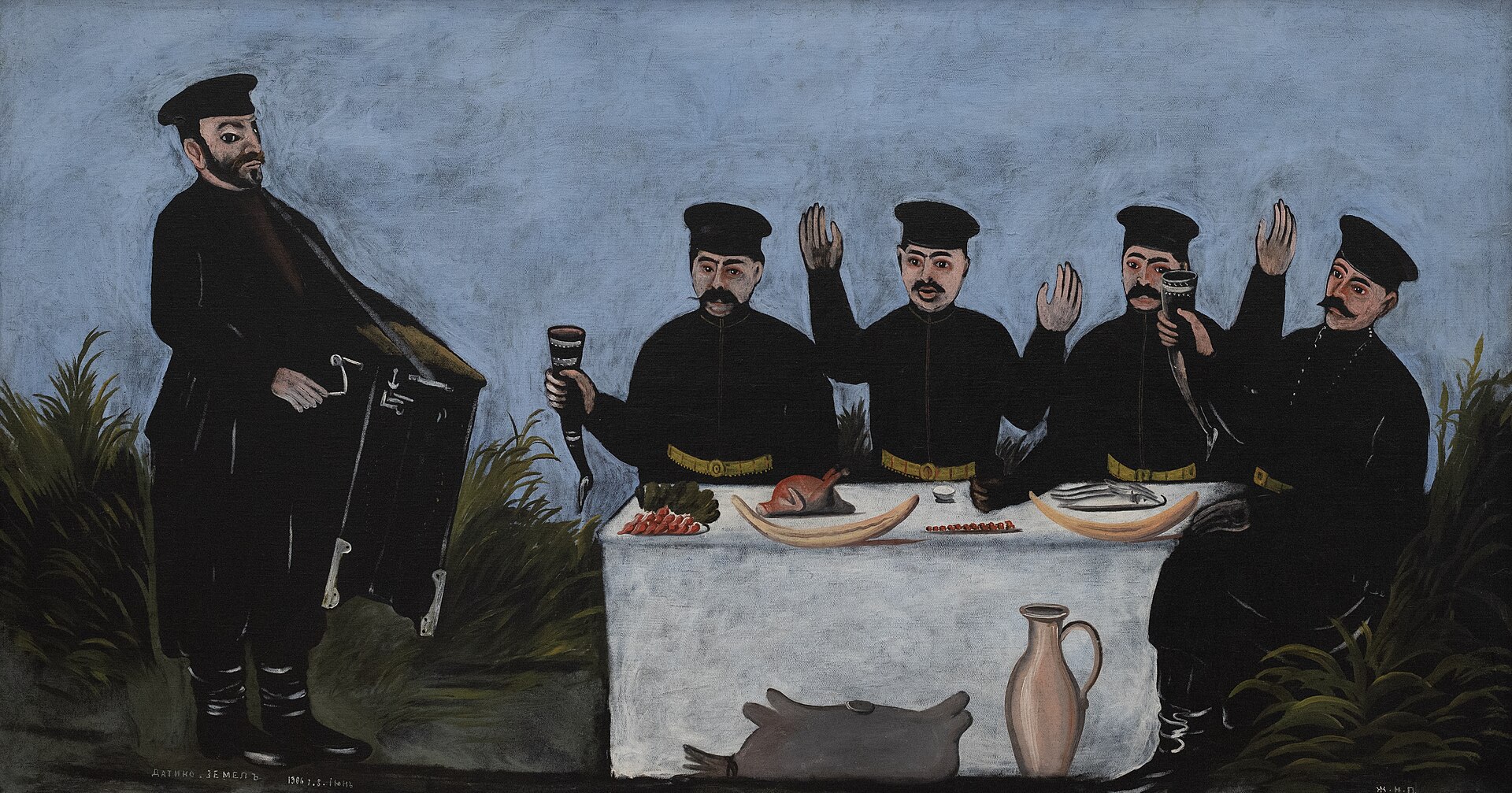
schemes is particularly evident in Pirosmanashvili's table compositions, which
are frequently associated with medieval feast scenes: this is conveyed through
the symmetrically disposed, undisturbed abundance of the spread table, the
static postures of the figures, and the similarity of gestures (the raised
vessel as a gesture of blessing).
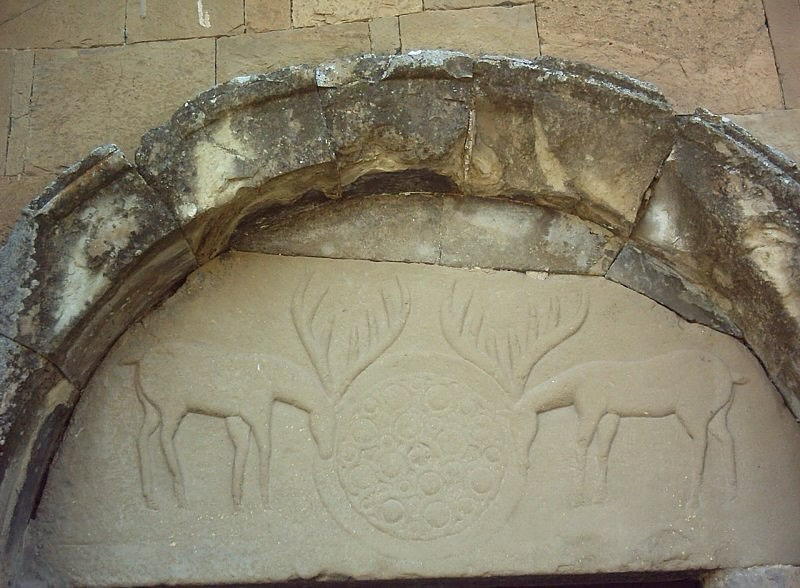
Ateni Sioni Church, Tympanum Stone Carving, 5th century
._Deer_with_their_Fawns._Cardboard,_oil._103x82cm__1.jpg)
Niko Pirosmani, Three Deer at the Spring, Georgian National Museum
A special place in Pirosmanashvili's
work is occupied by animal imagery, whose anthropomorphic sensitivity has been
repeatedly noted by scholars. It is especially noteworthy that the artist’s preference
consistently falls upon animals that embody the most widespread Christian
symbols. Among these the deer/stag occupies a prominent position. Medieval
Georgian art is marked by a particular abundance of deer imagery, which can
itself be considered a continuation of the pagan tradition widespread in
pre-Christian metalwork. In the relief decoration of medieval churches and in
mural painting, however, these images already acquire an explicitly Christian
symbolism. Significantly, of the eighteen compositions Niko Pirosmanashvili
dedicated to the theme of the deer, seven depict deer and does drinking at the
water — an image that finds a direct parallel in the medieval scene of deer
drinking at the stream (e.g., the illustration of Psalm 41.2 on the tympanum of
the northern entrance of Ateni Sioni Church, 5th c.), which represents the
symbolic image of a soul seeking to embrace Christianity.
Among Niko
Pirosmanashvili's most beloved animals, judging by the number of works
dedicated to it, is the lamb — an image clearly linked to the Christian
symbolism of the Lamb of God (Agnus Dei) and its association with the
Resurrection. In works such as "The Easter Lamb" and "The Lamb
on the Graveyard," the lamb represents the sacrificial offering, thus
bearing Christian symbolism.
The eagle, too, is a
widespread image in medieval art, frequently found on church façades and
capitals, often shown seizing a hare or other creature as a symbol of power and
victory (e.g., the reliefs on the eastern façade of Ateni Sioni Church, 7th c.;
the southern façades of the Oshki and Kakhuli churches, 10th c.; the column
capital of Bagrati Cathedral, early 11th c.; and others). It is especially
noteworthy that Pirosmanashvili's "The Eagle with the Seized Hare"
directly follows this medieval iconographic scheme in its compositional
structure.
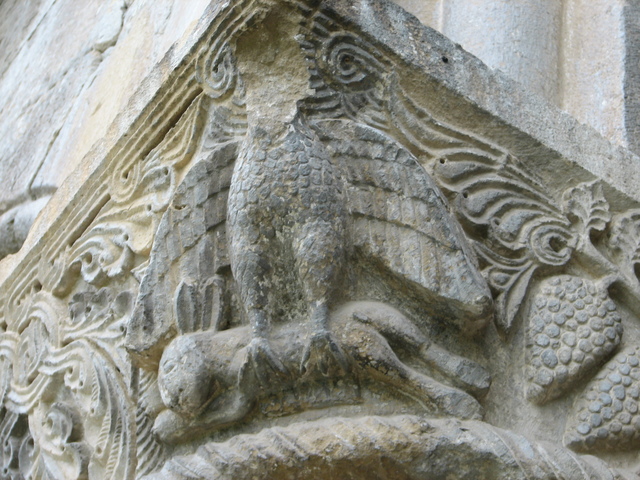
Bagrati Cathedral, Column stone Carving, 11th
century
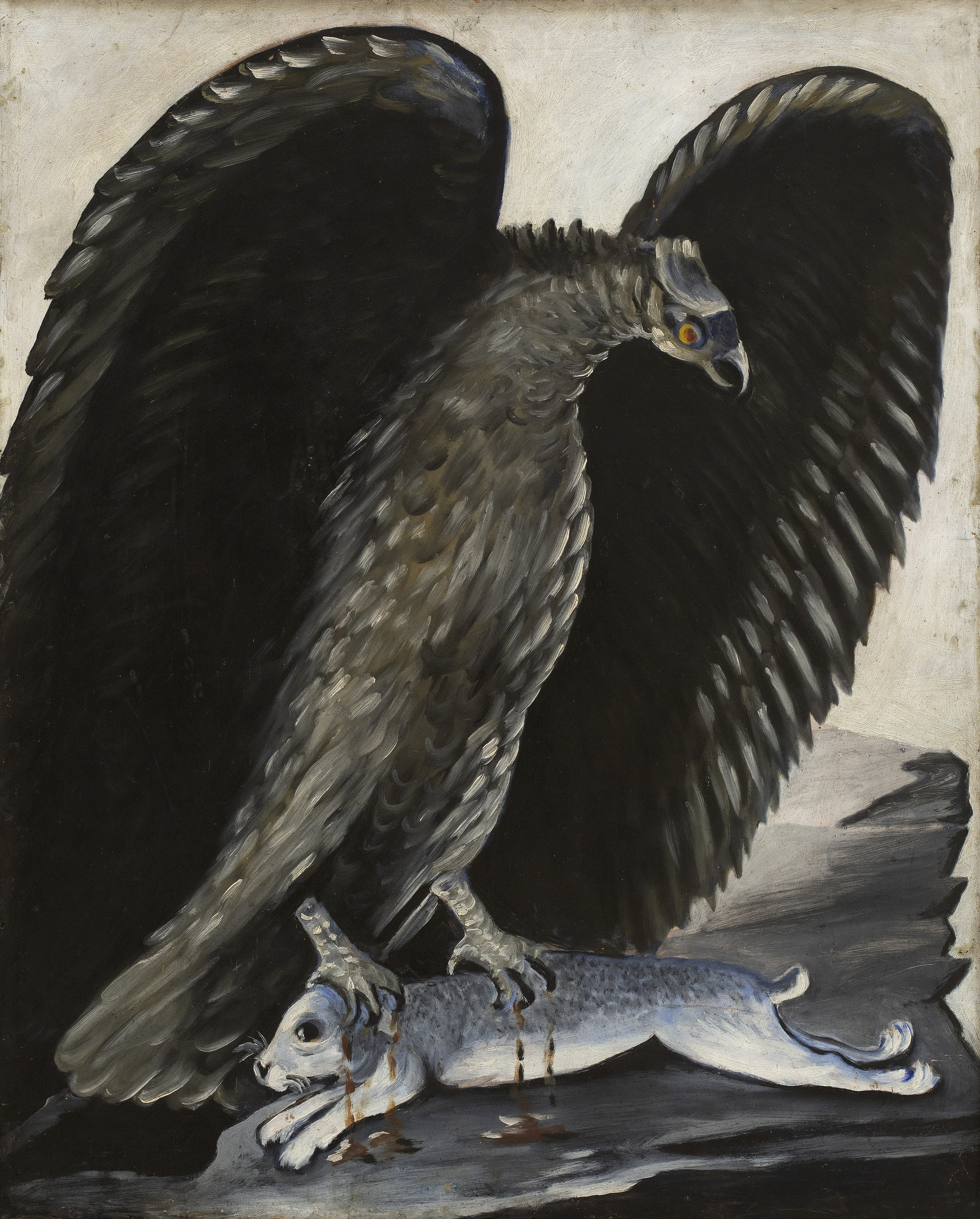
Niko Pirosmani, The Eagle seizing the Hare, Georgian National Museum
Among the
"medieval" features of Pirosmanashvili's art are the inscriptions
accompanying the majority of his works. These inscriptions serve an explanatory
function: as in a traditional medieval fresco or icon, they help unveil the
idea of the painting while also playing an important role in the structure of
the composition. Like the texts on medieval icons, the inscriptions in
Pirosmanashvili's works help engage the beholder.
Pirosmanashvili's
portraits are often compared to medieval icons. This effect is achieved through
the direct eye contact established by the figures and through the artist's
distinctive treatment of time and space. The depiction of eyes carries great
significance in medieval Christian art, where the eye is considered the
"mirror of the soul" — a kind of symbol of man's eternal existence.
That is precisely why, in Christian murals and icons, the size of the eye is
sometimes emphatically exaggerated, allowing for the establishment of direct
contact with the prototype. It is through this very directed gaze, this eye
contact, that Pirosmanashvili's portraits, too, draw closer to the beholder.
His portraits, like
figures in medieval frescoes, are almost always presented frontally or in
three-quarter turn, standing at full height ("Georgian Woman with
Tambourine (Dayereh)," "Queen Tamar," "Karachokheli with a
Horn of Wine," "The Nobleman with a Horn," "The Actress
Margarita," "The Janitor," "The Fisherman," "The
Cook"). Furthermore, the figures in Pirosmanashvili's individual and group
portraits, like those in medieval icons, gaze outward from the picture plane
toward the beholder — direct eye contact being one of the defining features of
icon imagery.
Unlike the illusion
of time usually created on the picture plane through movement and dynamic
postures, Pirosmanashvili's figures are static, still, and solemn, as though
existing beyond the dimensions of time and space. The grape-harvesters
("Sviri"), the captive prisoner and his escort ("Feast of St.
George in Bolnisi"), even the dancers are presented motionless and solemn
("Wedding in Old-Time Georgia," "Church Festival in
Kartli"). This creates a medieval, "timeless" character in the
compositions.
The treatment of space in Pirosmanashvili's pictures is
largely determined by his use of black oilcloth, which, as both a technical and
artistic means of expression, plays an important role in creating his unreal,
illusory imagery. The oilcloth is left bare and unpainted wherever the
composition calls for black, since the bare black oilcloth itself serves as
that black background. This cuts the depicted objects off from any
real environment and pushes them instead toward the real space between the
picture plane and the beholder. The effect can be compared to the neutral gold
background used in Christian art — a means not of depicting a specific, real
environment, but of creating the impression of an unreal, illusory world, while
also establishing direct contact between the image and the spectator. In
medieval icons and wall paintings, the image is not separated from the beholder
by the "imaginary glass pane" of the picture plane, behind which an
illusionistic scene begins; instead, it opens into the real space in front,
where the beholder lives and moves. The same principle is especially evident in
Pirosmanashvili's portraits, where the portrayed person or object, set against
the black oilcloth, is depicted frontally, in the foreground of the picture,
and is most often placed in close interaction with the beholder.
The blackness of the
oilcloth also carries symbolic meaning for Pirosmanashvili, as attested by
words he addressed to Lado Gudiashvili: "Life is a contrast, I understand
this clearly — rich and poor, black and white. In life everything has two sides:
good and evil. Here is a white cow, a symbol of peace, tranquility, and love.
White is the color of love. The black bull fights and roars — it is war… When I
paint the sad beauties of Ortachala, I place them against
the background of a 'black life.' But they too have love for life — this is
expressed through the flowers placed around them, the birds at their shoulders.
I paint them wrapped in white sheets. I pity them, and with white I remit their
sins…" Pirosmanashvili's use of the oilcloth's blackness as a symbol of
"black life," and the whiteness of the sheet as a means of
"remitting sins," recalls the color symbolism of medieval art, where
every attribute and every color carries deep symbolic and meaning.
When discussing the
sources of Pirosmani's "iconographic" repertoire, it is important to
consider, alongside its medieval origins, various phenomena of contemporaneous
visual culture — such as the easel portraits of his period, gravestone imagery,
different branches of folk craftsmanship, the figurative imagery of Old Tbilisi
silverware, and contemporaneous photographic portraits.
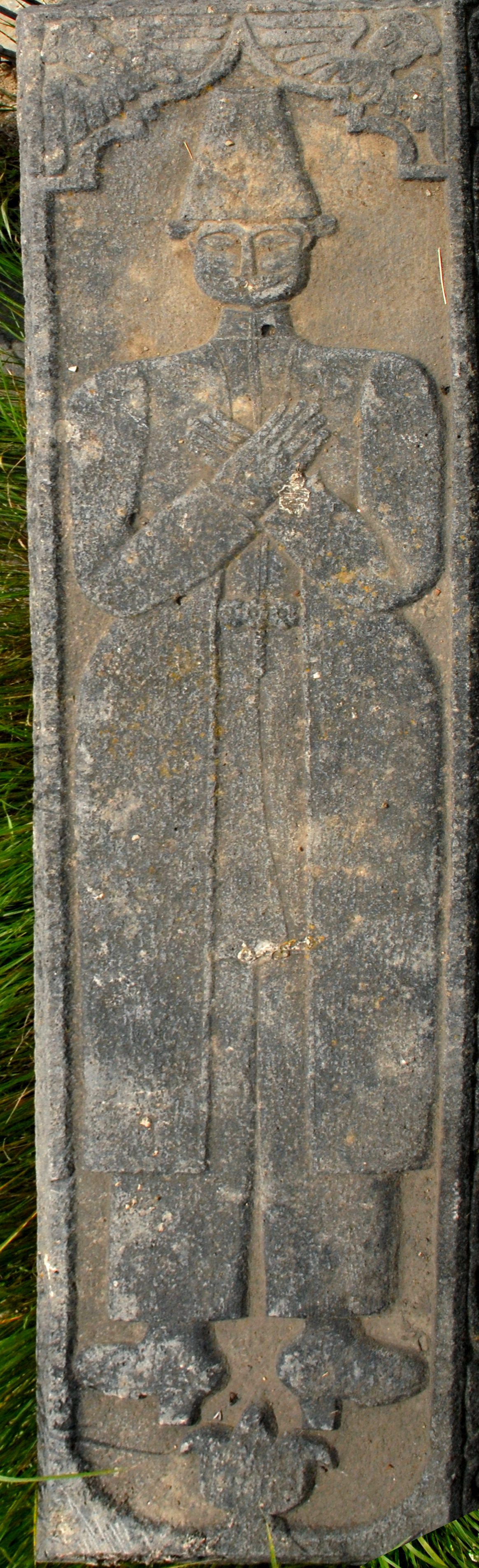
The portrait of Karachogeli on the 19th century gravestone at Kukia Cemetery, Tbilisi
In this regard, the
figurative images found on 19th-century gravestones are of particular interest.
Given the wide territorial spread of gravestone decoration across different
social strata of rural and urban populations alike, it can be assumed that this
tradition must also have exerted significant influence on Pirosmanashvili's
work. Near Pirosmanashvili's house-museum in his native village of Mirzaani,
gravestones featuring full-length portraits of the deceased in traditional
garments are still scattered around the small hilltop church. The connection is
further attested by the recollections of David Gozalishvili, a stonecarver from
Signagi. He recalls that his father, Vano Gozalishvili, ran a
gravestone-carving workshop in Signagi, where Niko Pirosmanashvili was a
frequent visitor. According to D. Gozalishvili, the stonemasons would often ask
the painter to sketch the outline of a chokha-clad man or a woman in
traditional headgear (chikhtikopi) directly on the gravestone slab, after which
the craftsmen would carve the figure accordingly (Soflis Tskhovreba, 19 January 1961). This
little-known fact is especially significant, as it provides additional evidence
for the connection between Pirosmanashvili's work and gravestone decoration. Particularly striking parallels are found at
the old Kukia and Saints Peter and Paul Cemeteries in Tbilisi, where, alongside
the village-typical chokha-clad and chikhtikopi-wearing figures, one also
encounters people dressed in contemporary European styles. Preserved here, too,
are gravestones depicting old Tbilisi types — the kinto and the karachokheli —
rendered with their characteristic details. Juxtaposing the figurative images
preserved at the old Tbilisi cemeteries with Pirosmanashvili's portraits
reveals not only a shared period spirit, but a
striking iconographic and stylistic resemblance. Brought
together, they reflect the rich multicultural patchwork for which Old Tbilisi
was famous.
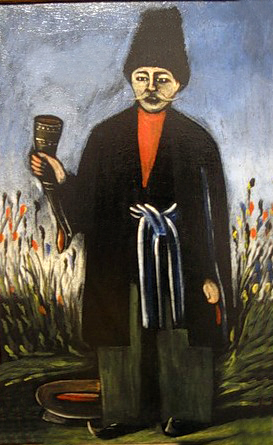
Niko Pirosmani, Karachogeli with drinking horn, Georgian National Museum
The gravestone in itself doesn’t provide a space and
for meticulous storytelling. Hence, the language applied both in visual
representation and in texts – or epitaphs – is extremely summary, highlighting
only the key facts about the life and deeds of a deceased person. Namely,
Pirosmanashvili’s portraits often referred to as “portrait-types, do not focus
on the individual person as such; in contrast, they represent generalized, even
“collective” images, incorporating only a few determining attributes, which capture
the essential features and single out details that allude to the social class
or profession of the portrayed person. In the same way that the image of scissors, a carding
comb, or a sewing machine next to the portrait on the gravestone comments on
the life of a craftswoman, the weapon on a fighter, the plough of a farmer, so
too the singled-out attributes (a spoon tells us the story of a cook, as does a
fish in hand for a fisherman) determine the profession/class of the people in
Pirosmanashvili’s portraits.
Apart from the shared iconographic schemes between
Pirosmanashvili’s portraits and gravestone figurative images, there are number
of motives and sign-symbols, which speak to the common features between these
two phenomena. Among these are animal
images, which mostly bear sacrificial symbolic (sheep, stag, goat,
bull). Gravestones
often feature birds and flowers, which allude to the harmony of the Garden of
Eden. Interesting
parallels are also attested between Pirosmanashvili's work and gravestone
decoration in the imagery of birds and flowers, where the bird appears as
"the bird of life" and the flower as a symbol of life and youth. Niko
Pirosmanashvili's use of birds and flowers as symbols of "love of
life" resonates in its own way with the significance of these motives in
memorial culture.
Furthermore, Pirosmanashvili’s familiarity with the
specifics of gravestone language is reflected in the image of the cherub motif - angel with
wings (without body), that is particularly characteristic of gravestone images
and appears in two of Pirosmanashvili’s works, “The Lamb at the Cemetery with
Angels” and “Easter Still Life.” These creatures are most frequently found at
the corners of tombstones, and it is unsurprising that we also find them in a
cemetery context in Pirosmanashvili's work.
The existence of a universal model for
the memorial portrait and its accompanying program — one that spread throughout
the country from the early 19th century through the early 20th century and
encompassed all social strata — explains the clear precedents for the
incorporation and use of this visual repertoire in the work of the self-taught
artist.
Other similar connections between Pirosmanashvili's paintings and various filed of folk decorative-applied arts
can
be seen in
the figurative and zoomorphic imagery incorporated of folk ceramics, carpets and rugs,
and woodcarving. Amongst these however, the Old Tbilisi silverware demands special attention, as its decoration system and Pirosmanashvili's
thematic-iconographic repertoire reveals great affinity.
Old Tbilisi at the turn of the 19th and 20th
centuries was a renowned center of craftsmanship, where guild workshops
produced silver objects of various forms and purposes. The majority are wine
vessels: azarpheshas (wine ladles), bowls, karkaras (jugs with spiral-twist
spouts), jugs, kulas, mataras, horn vessels and others. This group of silver
objects is executed in the repoussé technique, with surfaces covered in floral
ornament within which figural images are incorporated in profiled cartouches. The close examination of the
figurative imagery of the silverware unveiled number of aspects, which are
closely related to the iconography of Pirosmanashvili’s works.
Among the silverware patterns we can often see animal images, such as
lions, stags/deer, lambs, eagles with the seized prey, which find parallels in
Pirosmanashvili’s animal series.
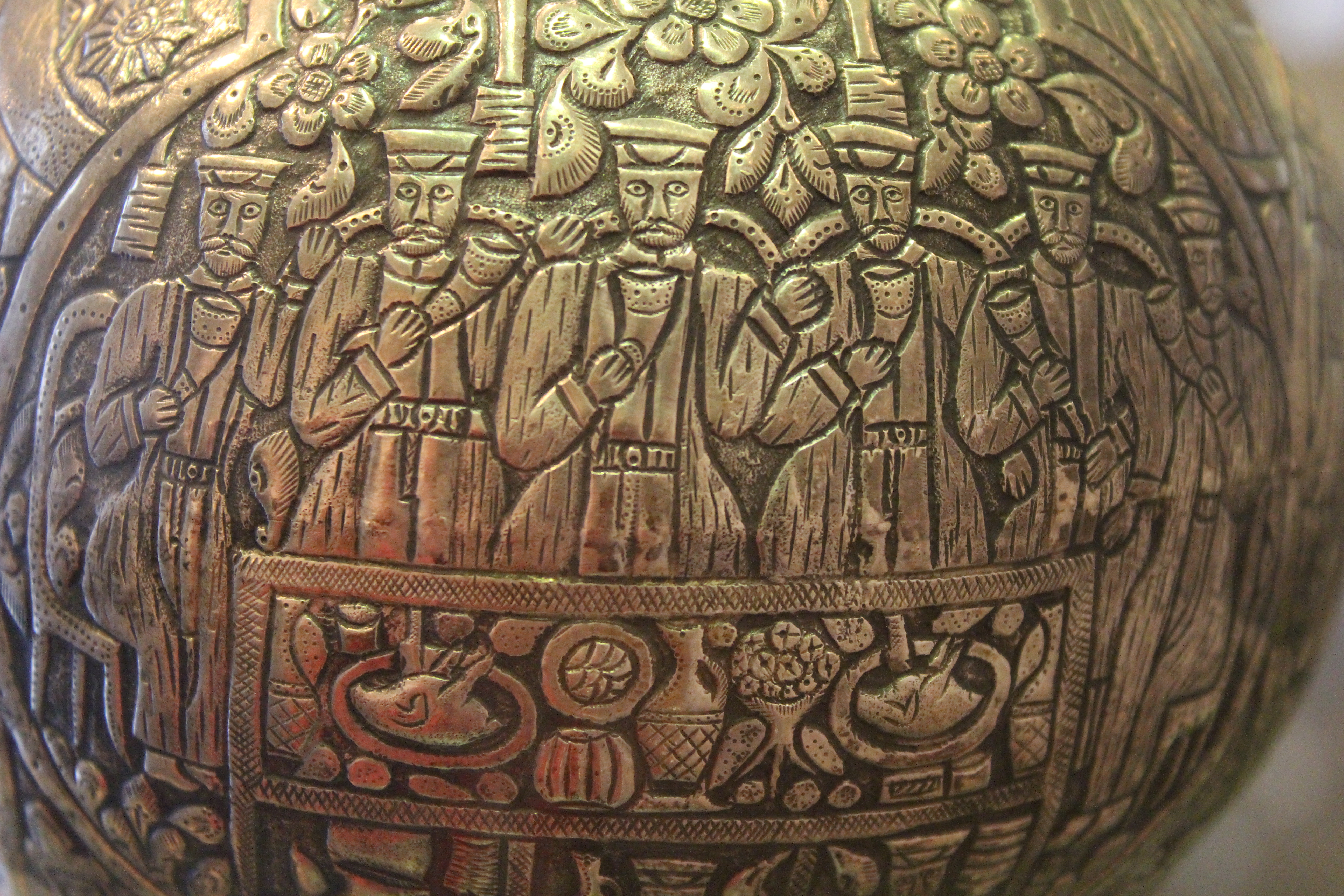
Feast on the 19th century silver Karkara
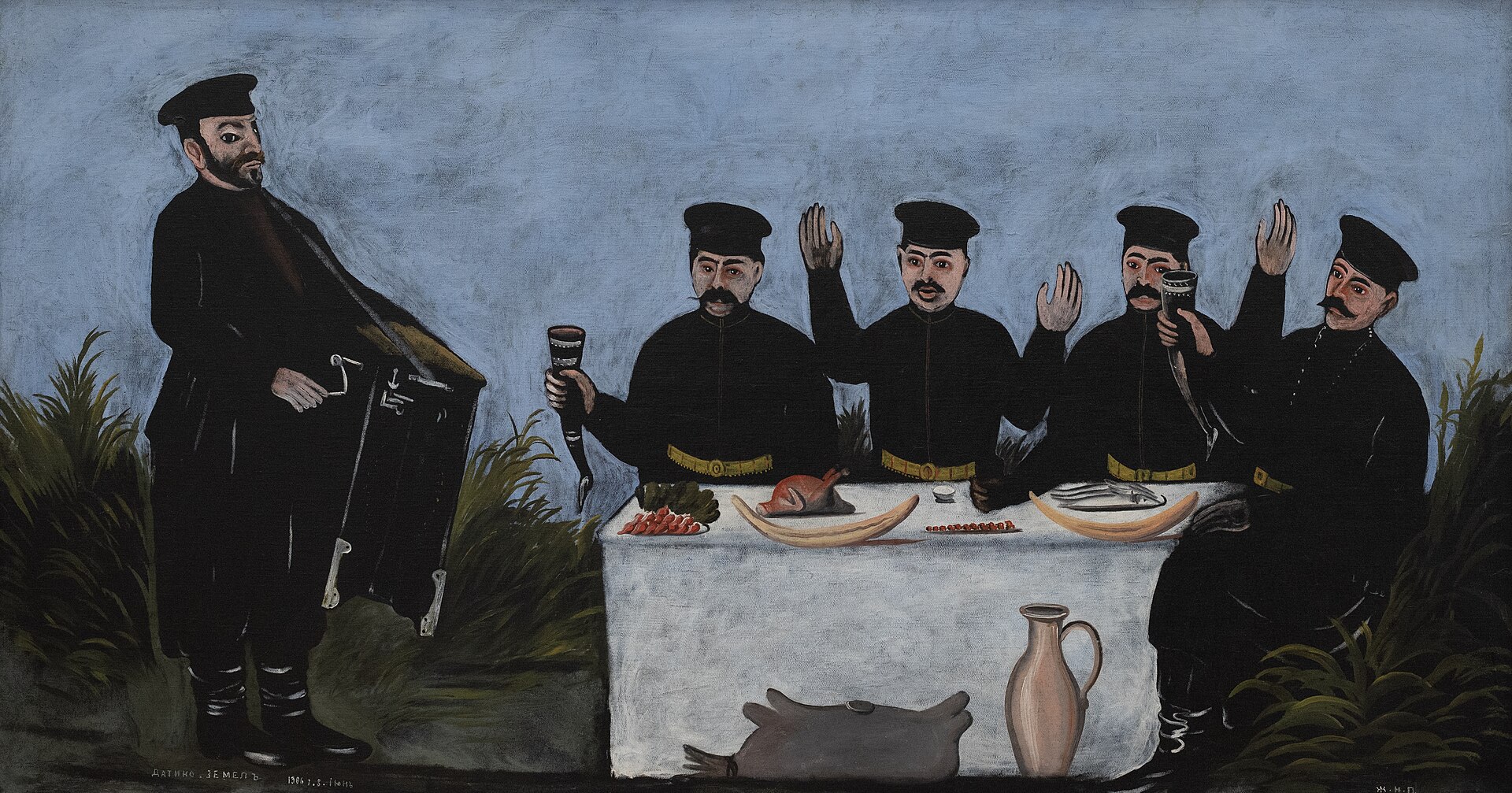
Niko Pirosmani, Feast at Datiko Zemeli, Georgian National Museum
The silverware decoration also often
features feast scenes frequently associated with wedding themes. These
primarily depict church wedding ceremonies, a dancing couple accompanied by
zurna and duduk, and table scenes showing women and men feasting. Their frontal
compositional alignment, solemn character, and manner of rendering the spread
table are reminiscent of the iconography of Pirosmanashvili's feast
compositions, e.g., "The Feast with Organ-Player Datiko Zemeli." This
resemblance is expressed in the similar rendering of the "still life"
on the table (roasted chickens, bottles, plates), the frontal depiction of the figures, their
postures (raised horn vessels), and their garments and accessories. The same
can be said of the distribution of figures and their gestures (dancing,
clapping) in the wedding and dance scenes, which are identical to the features
seen in Pirosmanashvili's pictures "Church Festival in Kartli" and
"Festive Easter Table." Similarities are also evident in the frontal
depictions of musicians, with their instruments emphasized, and in the images
of karachokheli and kinto types, where the characteristic details of their
garments are rendered with great precision. Other vivid examples of shared
schemes are Pirosmanashvili's series "Georgian Woman with Dayereh"
and the images of women holding dayerehs found on silverware.
Among the parallels between the
silverware iconography and Pirosmanashvili's work, the theme of the historical
portrait deserves separate mention — particularly the images of Shota
Rustaveli, Queen Tamar, and Erekle II. The silverware decoration follows an
established iconography for these figures and reveals a great similarity to,
for example, Pirosmanashvili's paired portraits of Shota and Tamar, where the
pairing is thematically linked by a scroll bearing the text of "The Knight
in the Panther's Skin." Multiple examples of analogous paired portraits
exist in the decoration of various silver vessels, which speaks to the iconic
importance of "The Knight in the Panther's Skin" in that period, and
to the common perception of Shota Rustaveli and Queen Tamar as a couple. Here
too we must note Pirosmanashvili's interest in the figure of Imam Shamil
(1797–1871), an Avar political and religious leader of the Muslim tribes of the
Northern Caucasus, who likewise appears on silverware, as well as the portrait
"Giorgi Saakadze, the Great Mouravi" (1580–1629), whose iconographic
prototype — apart from the Don
Cristoforo De Castelli - (1600-1659) portrait — had until now been
unknown, and is in fact abundantly attested in silverware. This points to the
fact that Pirosmanashvili's series of historical portraits features characters very popular in
19th-century culture, which in turn serves as evidence of the strong influence
of folk origins and motifs on
Pirosmanashvili's work.
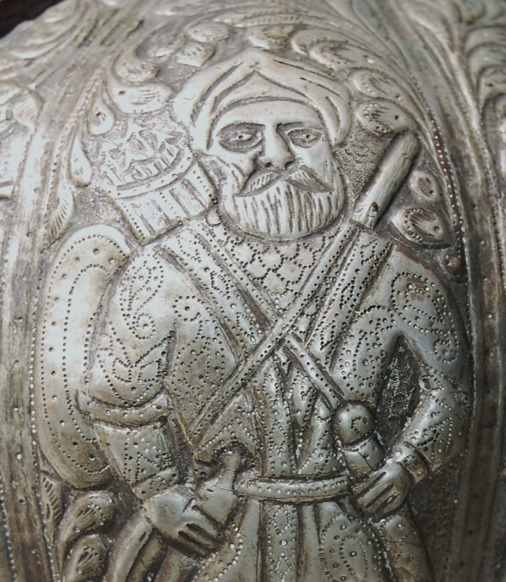
Giorgi Saakadze on the 19th century Silver Pitcher
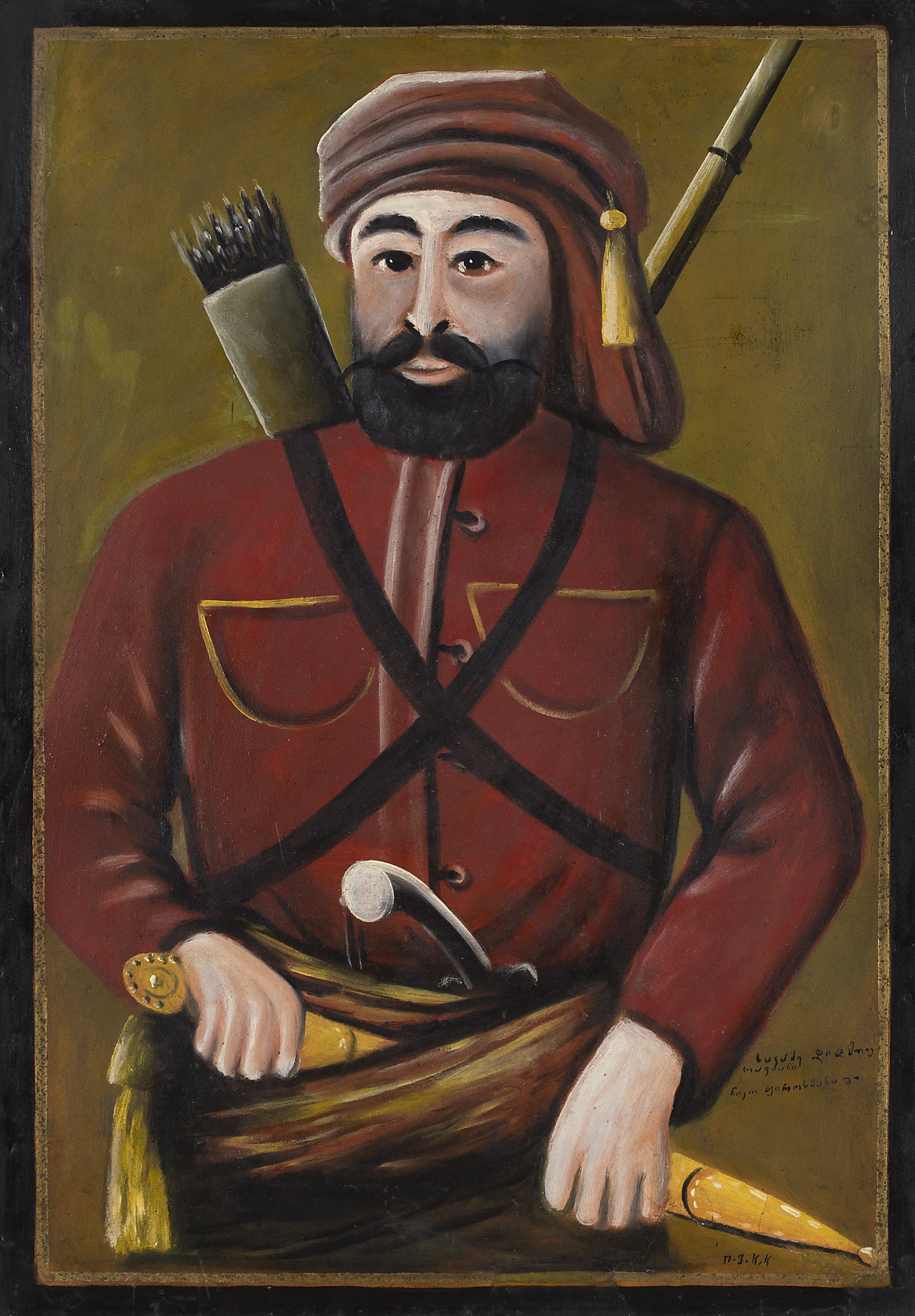
Niko Pirosmani, Giorgi Saakadze the Grand Mouravi, Georgian National Museum
When studying the artistic preconditions of
Niko Pirosmanashvili's work, the contemporaneous photography is also of
interest: the static frontality of the period's salon photographic portraits
and their full-height representation, the standard painted backdrops and the
existence of certain "universal" accessories that were an
indispensable part of the portrait "programme" for a person of a
given age, gender, profession or social class. The representative, static
character and a certain "timeless effect" go some way toward
explaining the same characteristics typical of Niko Pirosmanashvili's group and
individual portraits, which speaks to the shared thematic and iconographic
agenda facing contemporaneous visual culture — and in turn broadens our
perspective on the diverse artistic preconditions of the self-taught painter's
work.
Through the outstanding individual talent and
artistic vision, folk motifs in Pirosmanashvili's works are elevated and
transfigured into generalized, monumental paintings of striking power. The
significance of this phenomenon is further amplified by the intuitive
convergence of his pictorial language with the pioneering tendencies of the
contemporaneous avant-garde. Taken together, these qualities establish the
landmark significance of Pirosmani’s art, earning him his special place among the greatest
artists of his time.